Do You Need to Feel Sore After Pilates?


Estimated reading time: 6 minutes
By Dr Mert Eray Onen, Founder & Academic Director, EFWA · ORCID 0000-0001-8510-7293
No. A Pilates session can be useful without leaving you sore the next day. Soreness can accompany unfamiliar exercise, but its presence does not prove that a class was effective, and its absence does not mean that you need a harder one. Judge the session against its purpose: what you practised, the demand you managed and how your performance develops over time.
“I could really feel it the next morning” is an understandable description of an experience. It becomes less useful when treated as the verdict on a class. An instructor helping someone learn a controlled transition has a different immediate goal from one progressing a familiar strength exercise. Neither needs to promise an ache as evidence of success.
What next-day soreness can tell you
Delayed-onset muscle soreness, or DOMS, describes soreness that develops after exercise rather than a sudden pain during a movement. It commonly follows unfamiliar or unusually demanding work.
Eccentric muscle actions are particularly relevant: a muscle produces force while lengthening, as when controlling part of a lowering movement. Hody and colleagues’ review describes how unaccustomed eccentric exercise can provoke delayed soreness and temporary reductions in muscle function. Pilates contains opportunities for this kind of work, but the name of an exercise alone does not tell us which muscle is shortening, lengthening or holding at each moment.
For a learner, the useful question is what changed. Was the class unfamiliar? Was there a longer lever, a different range or more work than usual? Those details help an instructor understand the exposure. They do not allow a diagnosis from a message saying “my legs hurt”.
Why a familiar class may leave you less sore
The repeated-bout effect is one reason soreness can decrease after repeated exposure. In Doma and colleagues’ systematic review and meta-analyses, a second bout of multi-joint exercise generally produced less soreness and smaller disruptions in some performance measures than the first. The review included 20 studies of healthy adults.
These were not trials showing how every Pilates class should be progressed. They support a broader point: the same exercise can become less disruptive as a person adapts. Losing the next-day ache is therefore not, by itself, evidence that a useful exercise has stopped working.
Imagine a learner who initially finds a side-lying leg series unfamiliar. Several weeks later, the same variation feels more manageable and the following day is comfortable. That observation is a reason to review performance and goals. It is not an automatic instruction to double the repetitions, extend every lever and add another set simultaneously.
More soreness does not mean more muscle growth
Soreness, muscle damage and adaptation are related topics, but they are not interchangeable measurements. A person’s rating of discomfort is not a direct measure of new muscle tissue.
In their review of muscle damage and hypertrophy, Damas and colleagues concluded that muscle damage does not appear to be the process that drives or enhances resistance-training muscle growth. They discuss evidence that training can produce gains without substantial damage, and that early repair responses should not be confused with the processes supporting later growth.
That literature comes mainly from resistance training. It does not establish how much muscle any particular Pilates programme will build. Its practical contribution here is narrower: deliberately trying to make a learner sore is not a well-supported strategy for producing a better training response.

What to record instead
EFWA’s educational position is to assess progress against the task, with soreness treated as additional feedback. The following examples are coaching observations, not a validated scoring system.
For a movement-learning goal, note whether the learner can reproduce the sequence with fewer prompts and manage the transition deliberately. For a strength-oriented task, record a repeatable variation, range and amount of work, alongside the learner’s reported effort. If the set-up changes every session, it becomes harder to tell whether performance has changed.
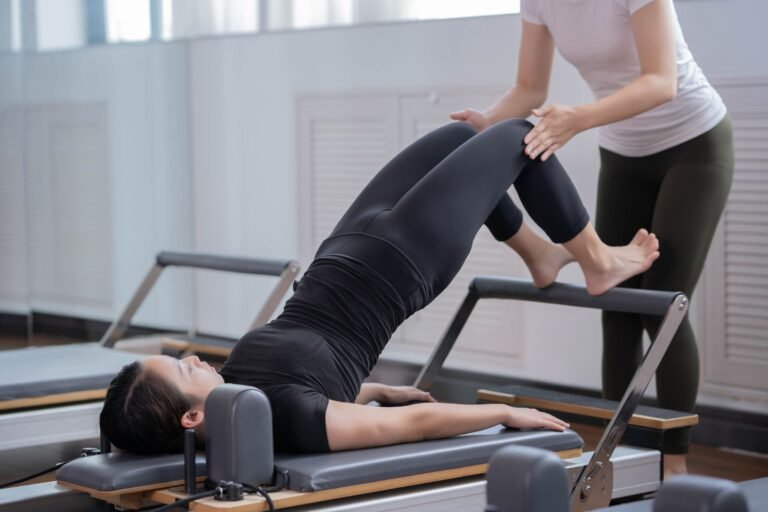
Consider a supported bridge. A useful note might be: “Completed the planned repetitions at the agreed tempo, maintained the intended range and needed fewer reminders than last week.” “No soreness afterwards” does not invalidate those observations. Nor would severe soreness improve that record.
Progression can then follow the goal. The instructor might choose a modest change to range, resistance or volume, explain its purpose and observe the response. More complexity is not necessarily the appropriate next step. EFWA’s progressive overload guide explains this broader programming principle.
The next session starts with a conversation
When a learner reports soreness, ask what they noticed, when it appeared, how it has changed and whether ordinary activities or familiar movements are affected. Avoid congratulating someone for struggling to walk after class: that can turn an unwanted response into something they believe they should chase.
Compare two teaching situations. One learner reports mild, improving muscle tenderness and is comfortable with familiar movements. Another reports pain that is worsening or makes movement difficult. These accounts should not receive the same automatic instruction to repeat the session unchanged. The instructor’s role is to consider a less demanding option, pause the relevant task or refer beyond their scope when appropriate—not to identify damaged tissue from the class floor.
A brief record of the exercise changes and subsequent response can help plan the following class. It is more useful than labelling a whole session “good” because it caused an ache. For programme structure, see how to plan a Mat Pilates class.
Stretching is not a guarantee against soreness
A comfortable stretch may have a place in a class, but it should not be sold as insurance against DOMS. Afonso and colleagues’ systematic review and meta-analysis did not establish a recovery advantage for post-exercise stretching over passive recovery. The evidence was sparse and confidence in the cumulative findings was very low.
That does not make stretching pointless. It means its purpose should be stated honestly, rather than promising that a longer final stretch will cancel out an excessive workload. Recovery gadgets and techniques also cannot replace sensible decisions about the next session’s demand.
Evidence limits and professional boundaries
Much of the research discussed here involves general resistance or eccentric exercise, not Pilates-specific programmes. It informs the interpretation of soreness; it does not supply a universal Pilates dose or prove that an individual is ready to train. The teaching examples are EFWA’s application of those principles.
Do not assume that every pain after class is DOMS. Pain that is severe, worsening, persistent or concerning should be assessed by an appropriate healthcare professional. Seek urgent medical attention for muscle pain that is much more severe than expected, marked weakness or tea- or cola-coloured urine after exercise; do not assume these symptoms are ordinary soreness. See CDC guidance on symptoms requiring immediate medical assessment. This article offers exercise education, not diagnosis or a treatment plan.
Explore related questions in the Pilates Knowledge Hub. For structured study of anatomy and teaching, compare EFWA’s Level 3 Mat Pilates Instructor Course.
References
- Afonso, J., Clemente, F. M., Nakamura, F. Y., Morouço, P., Sarmento, H., Inman, R. A., & Ramirez-Campillo, R. (2021). The effectiveness of post-exercise stretching in short-term and delayed recovery of strength, range of motion and delayed onset muscle soreness: A systematic review and meta-analysis of randomized controlled trials. Frontiers in Physiology, 12, Article 677581. https://doi.org/10.3389/fphys.2021.677581
- Centers for Disease Control and Prevention. (2026, October 28). Signs and symptoms of rhabdomyolysis. https://www.cdc.gov/niosh/rhabdo/signs-symptoms/index.html
- Damas, F., Libardi, C. A., & Ugrinowitsch, C. (2018). The development of skeletal muscle hypertrophy through resistance training: The role of muscle damage and muscle protein synthesis. European Journal of Applied Physiology, 118(3), 485–500. https://doi.org/10.1007/s00421-017-3792-9
- Doma, K., Matoso, B., Protzen, G., Singh, U., & Boullosa, D. (2023). The repeated bout effect of multiarticular exercises on muscle damage markers and physical performances: A systematic review and meta-analyses. Journal of Strength and Conditioning Research, 37(12), 2504–2515. https://doi.org/10.1519/JSC.0000000000004628
- Hody, S., Croisier, J.-L., Bury, T., Rogister, B., & Leprince, P. (2019). Eccentric muscle contractions: Risks and benefits. Frontiers in Physiology, 10, Article 536. https://doi.org/10.3389/fphys.2019.00536
About the author: Dr Mert Eray Onen is EFWA’s Founder and Academic Director. His academic interests include exercise physiology, applied anatomy and training science. ORCID: 0000-0001-8510-7293. Disclosure: EFWA provides Pilates instructor education.
Illustrative recovery setting. Photo: Kampus Production / Pexels, used under the Pexels licence. The photograph does not establish whether the person is sore.