How to Plan a Mat Pilates Class: An Evidence-Informed Framework

EFWA Pilates Knowledge
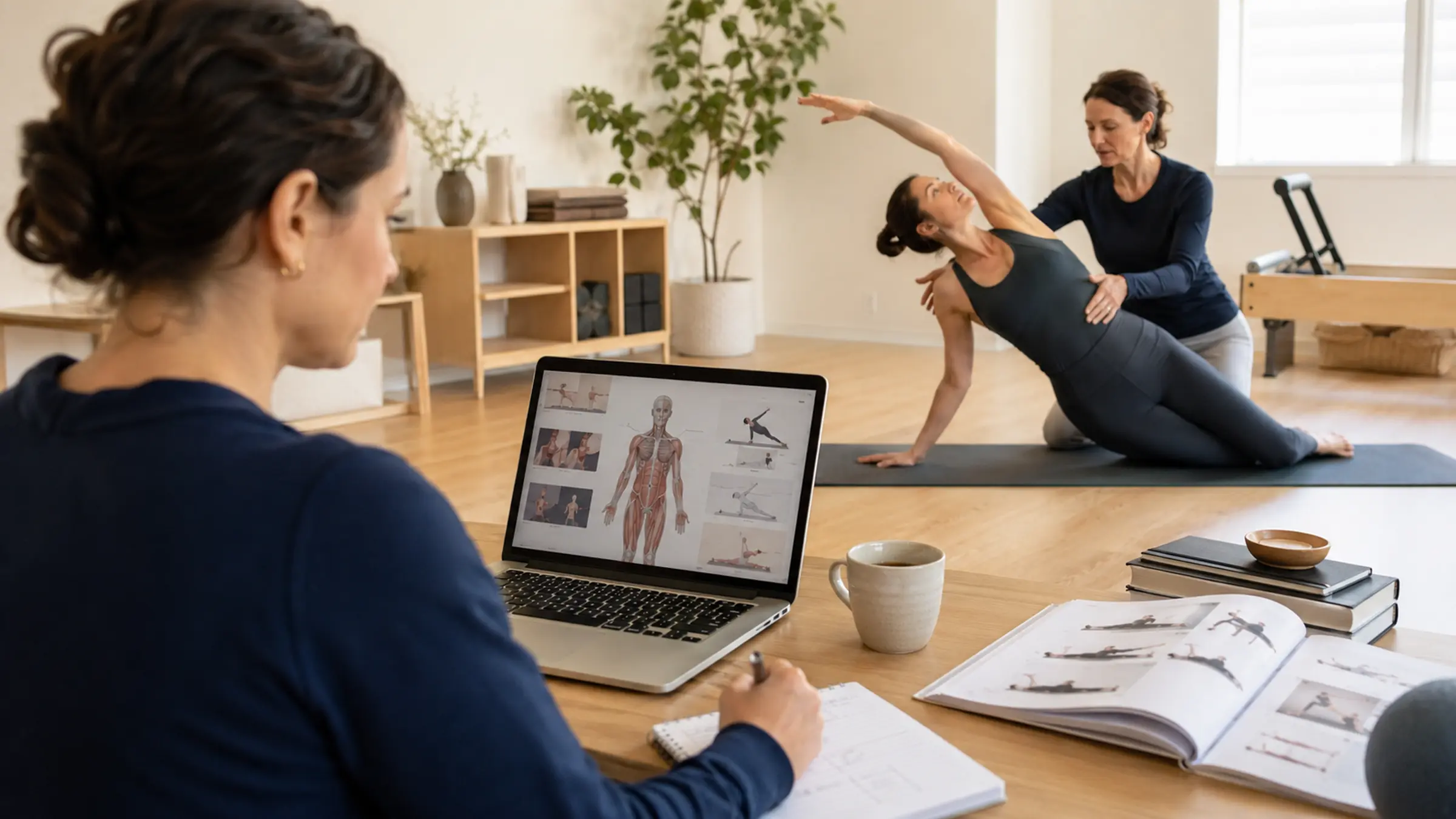
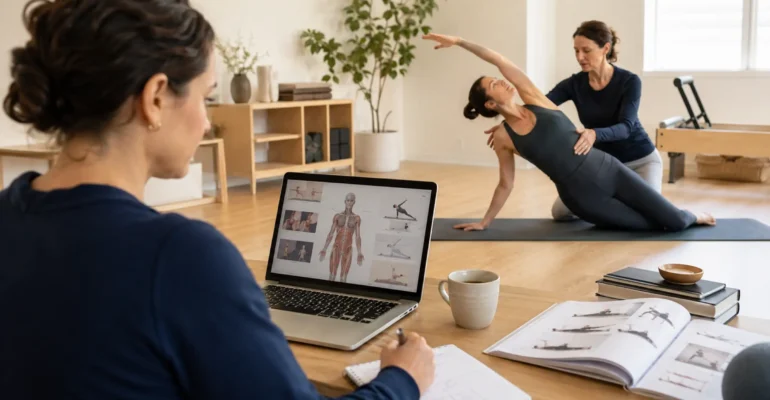
Direct answer: plan a Mat Pilates class by starting with the participants and one clear session objective, then selecting a coherent sequence, defining the intended dose, preparing meaningful options and deciding what you will observe. A class should not be a list of favourite exercises: each choice should support the stated goal and remain adaptable to the people in front of you.
What makes a class plan evidence-informed?
Pilates is commonly described as an exercise approach involving strength, core stability, flexibility, movement control, posture and breathing, delivered on a mat or with specialised equipment (Wells et al., 2012). That broad definition leaves considerable room for teaching traditions and professional judgement. Research does not provide one universally superior class order.
An evidence-informed plan therefore combines three sources: relevant research, the instructor’s professional expertise and the participants’ goals, preferences and responses. The plan should be specific enough to guide teaching but flexible enough to change when observation shows that an option is not serving the group.
The EFWA six-decision planning framework
EFWA educational position: this six-decision framework is an original teaching aid developed by EFWA. It is not presented as an established scientific standard or a universal Pilates sequence.
1. Identify the group and the boundaries
Record the expected experience level, group size, relevant screening information, equipment, space and session length. Clarify what the class is—and is not—designed to provide. A general group class is not an individual rehabilitation session, and an instructor should not diagnose the cause of pain.
Plan how you will respond if a participant reports symptoms outside your professional scope. New, severe or unexplained symptoms, progressive neurological signs, recent trauma or a significant change in function require an appropriate pause and referral pathway rather than a more inventive exercise variation.
2. Write one primary session objective
“Whole-body Pilates” is too broad to guide decisions. A more useful objective might be: “Participants will practise controlled trunk and hip movement while maintaining comfortable breathing across three positions.” Secondary benefits may occur, but one primary objective helps the instructor decide what deserves time and what can be omitted.
3. Build a coherent movement sequence
Arrange exercises so that the demands develop logically. Consider body position, contact with the floor, spinal and hip movement, upper-limb support, balance, fatigue and transitions. A sequence might move from familiar supine tasks to side-lying and quadruped work before a standing integration. That is a planning choice, not a compulsory hierarchy.
Avoid changing several difficult variables at once. Moving from a stable, symmetrical task to a smaller base of support, longer lever and unfamiliar coordination pattern may create confusion rather than useful progression.
4. Define dose and effort
For each exercise, decide whether repetitions, time, breathing cycles or movement quality will determine the dose. Note the intended effort and rest. More repetitions are not automatically better, and slower is not automatically harder. The dose should preserve the movement feature being taught.
General exercise guidance supports progressive, individualised doses for strength, flexibility and neuromotor fitness, but it does not prescribe a Pilates-specific formula (Garber et al., 2011). Use broad principles without pretending they validate one branded sequence.
5. Prepare a base option, regression and progression
A useful option changes the task in a way that addresses the observed problem. If balance is limiting a standing exercise, increase support. If lever length is dominating a trunk-control task, shorten it. If the participant has mastered the base version, progress one variable—such as range, load, base of support or coordination—while keeping the objective visible.
Do not label options as “beginner” and “advanced” when that creates status pressure. The most appropriate version is the one that lets the participant practise the intended skill with suitable challenge.
6. Decide what you will observe and cue
Choose one or two observable priorities per exercise: breathing continuity, contact with the floor, movement range, tempo or the relationship between two body segments. Long anatomical speeches can consume attention without improving performance.
Motor-learning research suggests that directing attention towards the effect of a movement can sometimes improve immediate performance compared with an internal body focus, but effects vary substantially across tasks and participants (Nicklas et al., 2024). Use both external and internal cues purposefully. For example, “slide the mat away” may help one participant, while “keep the pelvis quiet as the leg moves” may help another.
A worked 45-minute general Mat class
The following example is for screened, apparently healthy adults with mixed beginner-to-intermediate experience. It is an illustration, not a universal prescription.
- 5 minutes — arrival and orientation: confirm today’s objective, invite participants to report changes and establish a comfortable breathing rhythm.
- 8 minutes — supine preparation: pelvic and rib-cage awareness, controlled knee folds and an accessible bridge variation.
- 10 minutes — trunk and hip control: alternating leg movement with a chosen lever length, followed by side-lying hip work.
- 10 minutes — quadruped and upper-limb support: weight shifts, contralateral reach options and a clear rest position.
- 7 minutes — standing integration: supported squat pattern, weight transfer and balance options.
- 5 minutes — review: lower the demand, revisit the objective and ask what participants noticed.
The sequence includes changes of position without excessive transitions. Each block has a base option and at least one meaningful modification. If the group needs more practice in the first two blocks, the instructor can shorten the standing section rather than rushing through the plan.
How to progress the plan across weeks
Progress does not require replacing the entire class. Retain enough familiar material for participants to recognise and refine the task. Change one main variable: add a small range, alter the lever, reduce support, introduce light resistance or combine two familiar elements. Then observe whether the intended quality remains.
The same principle explains why Mat and Reformer work cannot be ranked simply by apparatus. Springs, straps, gravity and support change the mechanical problem. See EFWA’s comparison of Mat and Reformer biomechanics.
Common planning mistakes
- Choosing exercises before defining the session objective.
- Using novelty as the main progression strategy.
- Offering many options without explaining which problem each one solves.
- Increasing range, lever length and instability simultaneously.
- Cueing every visible detail instead of selecting a priority.
- Following the written plan after the group’s response shows it should change.
Evidence limitations
Direct research on optimal Mat Pilates class sequencing, cue density and week-to-week progression is limited. Much of the relevant reasoning is extrapolated from broader exercise prescription and motor-learning research. Pilates studies also vary in content, instructor training, frequency and participant population. The framework above should therefore be treated as a transparent professional model to be tested and refined, not as proof of one best method.
The practical takeaway
A strong class plan answers six questions: who is attending, what is the objective, why is each exercise in the sequence, what is the intended dose, how can the task be adapted, and what will the instructor observe? Write those decisions clearly, then remain willing to change the plan when participants provide better information.
Explore the Pilates Knowledge Hub, compare EFWA’s Pilates teacher-training pathways, meet the Academic Team, or browse the wider EFWA Knowledge Hub.
References
- Garber, C. E., Blissmer, B., Deschenes, M. R., Franklin, B. A., Lamonte, M. J., Lee, I.-M., Nieman, D. C., & Swain, D. P. (2011). Quantity and quality of exercise for developing and maintaining cardiorespiratory, musculoskeletal, and neuromotor fitness in apparently healthy adults: Guidance for prescribing exercise. Medicine & Science in Sports & Exercise, 43(7), 1334–1359. https://doi.org/10.1249/MSS.0b013e318213fefb
- Nicklas, A., Rein, R., Noël, B., & Klatt, S. (2024). A meta-analysis on immediate effects of attentional focus on motor tasks performance. International Review of Sport and Exercise Psychology, 17(2), 668–703. https://doi.org/10.1080/1750984X.2022.2062678
- Wells, C., Kolt, G. S., & Bialocerkowski, A. (2012). Defining Pilates exercise: A systematic review. Complementary Therapies in Medicine, 20(4), 253–262. https://doi.org/10.1016/j.ctim.2012.02.005
This article is an educational planning resource and does not replace individual assessment, clinical care or local professional requirements.
Author disclosure: Dr Onen is EFWA’s Founder and Academic Director. EFWA provides professional education in this subject area.