Pilates Cueing: How to Tell Whether an Instruction Helps

By Dr Mert Eray Onen · ORCID 0000-0001-8510-7293
Estimated reading time: 6 minutes
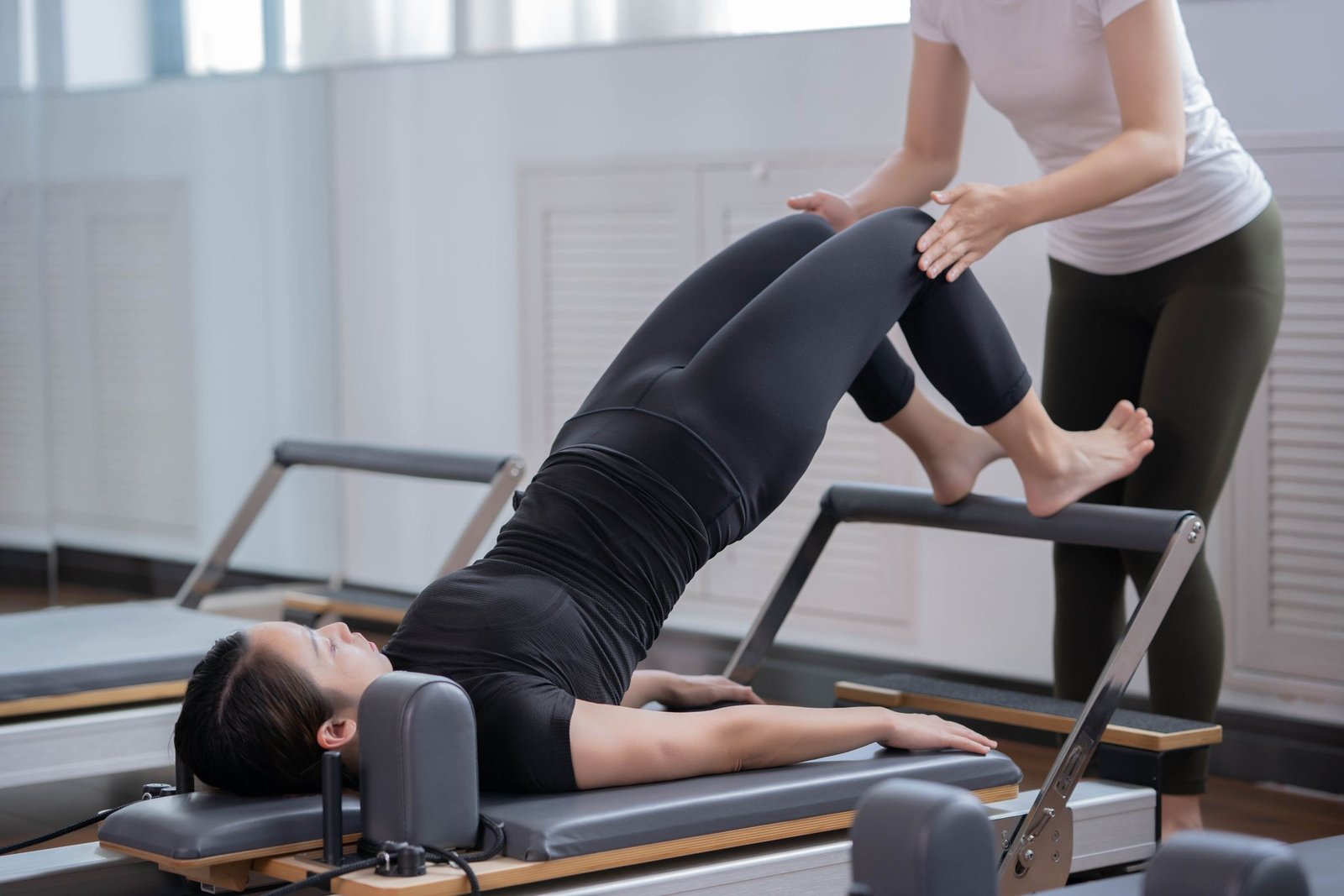
Cover image: an illustrative Reformer Pilates teaching scene. Photo: Nicholas Fu / Pexels.
A useful Pilates cue helps a learner understand or perform the task you intended. Judge it by the learner’s response, then check whether the skill remains when the prompt is removed. There is no established ideal number of words per repetition, and research does not justify treating one style of instruction as universally superior.
Imagine teaching a seated arm movement. You explain the starting position, movement direction, pace and stopping point. The learner begins correctly. Before adding a fifth instruction, ask what it would change. Sometimes the next useful teaching action is observation; sometimes it is another explanation or a demonstration.
First decide what the sentence is for
A setup instruction establishes the task. A cue directs attention during it. Feedback tells the learner something about an attempt. These jobs can overlap, but separating them helps an instructor avoid correcting an exercise that was never clearly explained.
For example, “Slide your heel forward and return” describes an action. “Keep the heel in contact with the mat” adds a specific priority. Afterward, “Your heel stayed down throughout that repetition” reports an observable result. “Good” offers encouragement, but leaves the learner guessing which feature you valued.
Before the class, write the purpose of the exercise beside the words you intend to use. Our Mat Pilates class-planning guide helps establish that wider objective. Cue selection is the smaller decision about how to communicate it.
Body cues and movement-effect cues both need a purpose
An internal focus directs attention towards the body: “straighten your elbow”. An external focus directs attention towards the intended effect on the environment: “move the handle towards that marker”. Neither category tells you whether a sentence is clear, appropriate or understood.
A substantial 2021 meta-analysis reported advantages for an external focus in performance and learning (Chua et al., 2021). However, a 2024 reanalysis found evidence of publication bias and much smaller average effects after adjustment (McKay et al., 2024). This disagreement matters when research is translated into a teaching rule.
A September 2026 network meta-analysis adds another complication: reclassifying the actual instructions changed their rankings, and some comparisons were sensitive to small-study effects (Peng et al., 2026). A label such as “external” therefore needs scrutiny. These studies do not establish the best phrase for a particular Pilates exercise.
EFWA’s educational position: choose language that makes the intended task accessible, and keep checking its effect. An anatomical explanation may help someone locate a joint before moving. A target may clarify direction. An image may make sense to one learner and be confusing to another.
Try a small change you can actually evaluate
The following examples are teaching suggestions, not experimentally validated scripts. Use them within an exercise and level of difficulty already appropriate for the participant.
When the learner loses the movement direction
Suppose an adult learning a seated arm reach repeatedly changes direction. First check that your demonstration and words agree. Then offer a visible destination: “Reach towards this point.” Watch whether direction becomes more consistent. If the learner now reaches further than intended, clarify the endpoint rather than assuming the first cue succeeded.
When the learner can explain the task but cannot perform it
During a heel slide, the participant correctly describes the intended action but struggles to reproduce it. Repeating the explanation more loudly adds little information. Try a smaller movement range or a clearer demonstration, then ask what felt different. Record that you changed the task as well as the words; improvement cannot automatically be credited to cueing.
When an image distracts from the goal
A metaphor about balancing an imaginary object may produce an exaggerated effort to remain motionless. Replace it with a literal description of the movement you want. Ask the learner to explain the task in their own words. If their interpretation differs from yours, revise the instruction before adding detail.
How much feedback is enough?
Less feedback is not automatically better. A 2022 meta-analysis found substantial uncertainty and no significant overall advantage from reducing feedback frequency (McKay et al., 2022). A separate systematic review of adult gross motor and sport skills found promising results for added feedback, but the best timing, frequency and duration remained unclear; many studies had a high risk of bias (Petancevski et al., 2022).
In practice, allow time to respond when the participant understands the task and is proceeding appropriately. Speak again when there is useful information to add. Essential setup, equipment instructions and a needed stop instruction should never be withheld to meet a target for fewer words.
You can also agree how feedback will work: “Would you like me to explain that again, show it, or watch your next attempt?” This is a communication option, not proof that learner-selected feedback is always more effective. If you offer guidance through touch, explain it and obtain permission first; the learner can decline.
Check learning beyond the prompted repetition
Doing a movement successfully while hearing an instruction is an immediate performance result. Research distinguishes this from retention after a delay and transfer to another task or condition. A smooth repetition alone cannot demonstrate durable learning (Chua et al., 2021; McKay et al., 2022).
For an ordinary teaching check, return to a familiar exercise later and let the learner begin with the essential setup but without the extra prompt. Can they explain the goal and reproduce the feature you were teaching? If not, provide support again. This is an observation for planning, not a formal research test or a judgement of the learner’s ability.
A short teaching note can record the task, the exact phrase, the response and what happened on the later attempt. Keep other conditions reasonably similar if you want to understand the phrase’s contribution. Fatigue, range, resistance and a new demonstration can all make the comparison harder to interpret.
Evidence limitations and professional scope
The strongest sources discussed here pool varied motor tasks, rather than testing these Pilates scripts. Publication bias, inconsistent definitions and differences between tasks limit firm conclusions. Recent research refines the debate; it does not supply a universal cueing formula.
This article concerns exercise teaching, not diagnosis or rehabilitation. Do not use a new cue to explain away pain or concerning symptoms. Pause or adapt within your competence and use an appropriate healthcare referral when needed.
For your next class, review one instruction: what should it help the learner do, what changed, and can they repeat the task later? Explore more teaching questions in the Pilates Knowledge Hub. For structured study, compare the curriculum and requirements of EFWA’s Pilates instructor courses.
References
- Chua, L.-K., Jimenez-Diaz, J., Lewthwaite, R., Kim, T., & Wulf, G. (2021). Superiority of external attentional focus for motor performance and learning: Systematic reviews and meta-analyses. Psychological Bulletin, 147(6), 618–645. https://doi.org/10.1037/bul0000335
- McKay, B., Corson, A. E., Seedu, J., De Faveri, C. S., Hasan, H., Arnold, K., Adams, F. C., & Carter, M. J. (2024). Reporting bias, not external focus: A robust Bayesian meta-analysis and systematic review of the external focus of attention literature. Psychological Bulletin, 150(11), 1347–1362. https://doi.org/10.1037/bul0000451
- McKay, B., Hussien, J., Vinh, M.-A., Mir-Orefice, A., Brooks, H., & Ste-Marie, D. M. (2022). Meta-analysis of the reduced relative feedback frequency effect on motor learning and performance. Psychology of Sport and Exercise, 61, Article 102165. https://doi.org/10.1016/j.psychsport.2022.102165
- Peng, F., Yang, Z., Su, Y., Shi, Y., Lin, J., Zeng, Y., Li, G., Jia, X., Li, W., & Xie, Y. (2026). Reevaluating attentional focus on motor performance according to expertise: A stratified network meta-analysis. Psychology of Sport and Exercise, 86, Article 103215. https://doi.org/10.1016/j.psychsport.2026.103215
- Petancevski, E. L., Inns, J., Fransen, J., & Impellizzeri, F. M. (2022). The effect of augmented feedback on the performance and learning of gross motor and sport-specific skills: A systematic review. Psychology of Sport and Exercise, 63, Article 102277. https://doi.org/10.1016/j.psychsport.2022.102277