Pilates Fusion Classes: Smart Programming or Just More Fatigue?

Pilates Science & Teaching
Pilates Fusion Classes: Smart Programming or Just More Fatigue?
Pilates fusion can be coherent when added strength or aerobic work serves a clear purpose, but combining formats does not automatically make a class more effective—or more Pilates.
Estimated reading time: 6 minutes
What is a Pilates fusion class?
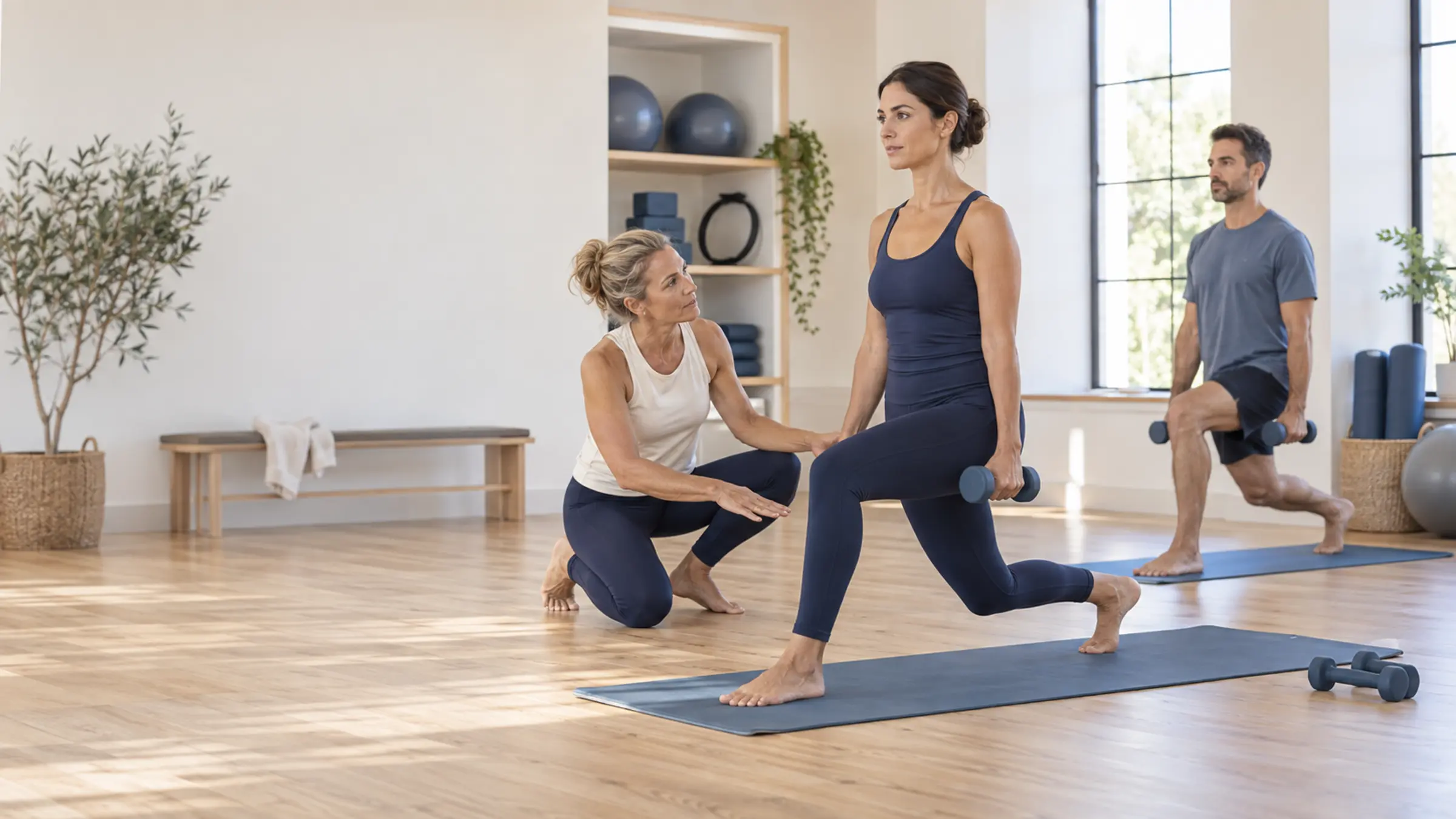
There is no single scientific or professional definition. In practice, “Pilates fusion” usually describes a class that blends Pilates-informed movement with another training element, such as dumbbell resistance, barre, yoga, circuits or short aerobic intervals.
That flexibility can produce a thoughtful hybrid session or an incoherent collection of exercises. The important question is not whether fusion is good or bad. It is whether the class has a clear objective, whether each component contributes to it, and whether participants are told honestly what they are attending.
Why Pilates fusion is growing in 2026
Pilates remains highly visible across studios, social platforms and home exercise. At the same time, participants increasingly look for sessions that appear to combine mobility, control, strength and cardiovascular challenge in one booking. Fusion formats respond to that demand and can help studios offer variety.
The commercial appeal is obvious, but it creates a teaching responsibility. A class should not add speed, heat, instability or load merely to look more advanced. Novelty is not the same as progression, and exhaustion is not evidence that the session achieved its purpose.
What can the evidence tell us?
Established evidence: training adaptations are specific
Exercise programmes tend to improve the capacities they repeatedly challenge. Resistance training is a precise way to develop strength and muscle when load, effort and progression are sufficient. Aerobic training challenges cardiorespiratory fitness when intensity and duration create an appropriate stimulus. Pilates programmes may improve selected aspects of muscular endurance, flexibility, balance and function, although study quality and programme content vary (Cruz-Ferreira et al., 2011).
A fusion class can expose participants to more than one stimulus, but twenty minutes of light resistance inside a mixed class should not be described as equivalent to a progressive strength programme. Similarly, a few breathless intervals do not automatically constitute a complete aerobic programme.
Established evidence: concurrent training is possible
Strength and aerobic training can coexist in a programme. An updated systematic review found that concurrent aerobic and strength training did not generally compromise muscle growth or maximal strength compared with strength training alone, although explosive strength may be more sensitive to how the sessions are organised (Schumann et al., 2022). This evidence concerns structured concurrent training, not branded Pilates fusion classes, but it counters the idea that different training qualities can never share a programme.
Emerging evidence: the fusion label itself
Direct research on the many classes marketed as Pilates fusion is limited. Formats differ too much for a single verdict: one class may use controlled loaded squats between Mat sequences, while another may prioritise rapid transitions and high repetition. Their training dose, teaching quality and participant experience are not interchangeable.
EFWA’s educational position: judge the actual session rather than the fashionable label. A hybrid class should state what it develops, preserve the coaching quality required by its exercises and avoid borrowing the authority of Pilates for methods that no longer reflect Pilates-informed practice.
What changes when strength or cardio is added?
The attentional demand changes
Participants have limited attention. New equipment, faster transitions and complex choreography consume some of it. If an instructor adds dumbbells while also changing foot position, tempo and breathing cues, learners may lose the movement quality the class was meant to develop.
The fatigue profile changes
Local muscular fatigue can be useful, but it can also reduce control later in the class. Cardiovascular intervals may make precise cueing harder to hear and execute. The instructor therefore needs to decide where fatigue belongs rather than allowing it to accumulate accidentally.
The progression system must change
A traditional Pilates progression might alter range, lever length, support, spring resistance, tempo or complexity. Strength work also needs an observable route of progression. Simply repeating the same light dumbbells every week may add variety without producing a meaningful long-term overload.
The EFWA FUSE framework for class design
Use FUSE before adding another method to a Pilates class.
FUSE is an EFWA educational framework, not a validated assessment tool.
- F — Function first. Write one primary class objective. “Improve controlled lower-body strength through Pilates-informed movement” is clearer than “full-body burn”.
- U — Unite the stimuli. Keep components that support the objective. A loaded squat may fit a lower-body strength theme; unrelated sprint intervals may not.
- S — Sequence for quality. Place technically demanding work while participants can still control it. Use transitions that allow equipment changes without rushed movement or avoidable trip hazards.
- E — Evaluate the dose. Record exercises, load, repetitions, effort and participant response. Decide whether future progression should change resistance, range, volume or complexity—not all of them at once.
Worked example: a coherent 50-minute fusion session
The stated objective is to develop lower-body strength and trunk control for adults already familiar with foundational Mat Pilates.
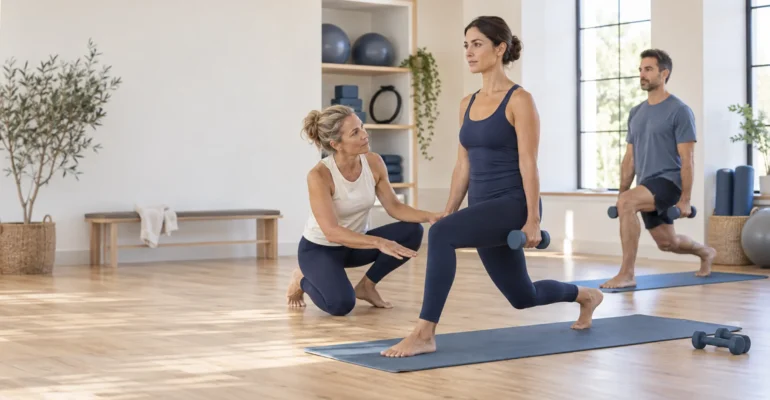
The instructor begins with a short movement preparation and rehearses the squat and split-stance patterns without external load. A central block alternates Pilates-informed trunk and hip-control work with two simple dumbbell exercises. Loads are individualised, repetitions stop before technique deteriorates, and the room remains organised so no one steps across loose equipment. The final section returns to lower-intensity Mat work and allows breathing and movement quality to settle.
This is not automatically a better class than a dedicated Mat or strength session. It is defensible because the elements share a purpose, the sequence protects learning, and the instructor can explain what the session does—and does not—provide.
When should a class use a different name?
If Pilates-informed principles, repertoire and teaching occupy only a small part of the session, a clearer name such as “strength and mobility” may be more honest. Accurate naming helps participants choose appropriately and prevents a popular term from carrying claims the session has not earned.
The same applies to instructor scope. Teaching light resistance or aerobic intervals requires the competence to select, demonstrate, progress and monitor those elements. A Pilates qualification does not automatically establish competence in every method added to a fusion class.
Evidence limitations
Research evaluates defined exercise programmes, while commercial fusion classes vary widely. Evidence from Pilates, resistance training and concurrent training can guide programme logic, but it cannot prove that every Pilates fusion format is safe, effective or superior. Outcomes also depend on training dose, instructor skill, participant experience and what people do outside the class.
The bottom line
Pilates fusion is a design choice, not an evidence-based category in its own right. It can be useful when the purpose is explicit, the added stimulus is measurable and movement quality remains teachable. If the combination relies mainly on novelty or fatigue, the class may be harder without becoming better.
Explore the EFWA Knowledge Hub, visit the dedicated Pilates Knowledge Hub, meet the Academic Team, read how to plan a Mat Pilates class, or compare EFWA’s Pilates Instructor Courses.
References
- American College of Sports Medicine. (2009). Progression models in resistance training for healthy adults. Medicine & Science in Sports & Exercise, 41(3), 687–708. https://doi.org/10.1249/MSS.0b013e3181915670
- Cruz-Ferreira, A., Fernandes, J., Laranjo, L., Bernardo, L. M., & Silva, A. (2011). A systematic review of the effects of Pilates method of exercise in healthy people. Archives of Physical Medicine and Rehabilitation, 92(12), 2071–2081. https://doi.org/10.1016/j.apmr.2011.06.018
- Schumann, M., Feuerbacher, J. F., Sünkeler, M., Freitag, N., Rønnestad, B. R., Doma, K., & Lundberg, T. R. (2022). Compatibility of concurrent aerobic and strength training for skeletal muscle size and function: An updated systematic review and meta-analysis. Sports Medicine, 52(3), 601–612. https://doi.org/10.1007/s40279-021-01587-7
- UK Chief Medical Officers. (2019). UK Chief Medical Officers’ physical activity guidelines. Department of Health and Social Care. https://www.gov.uk/government/publications/physical-activity-guidelines-uk-chief-medical-officers-report