Online Pilates Certificate: What Good Instructor Training Should Include

EFWA KNOWLEDGE HUB · PILATES EDUCATION
By Dr Mert Eray Onen, Founder & Academic Director, EFWA · ORCID 0000-0001-8510-7293
Estimated reading time: 6 minutes
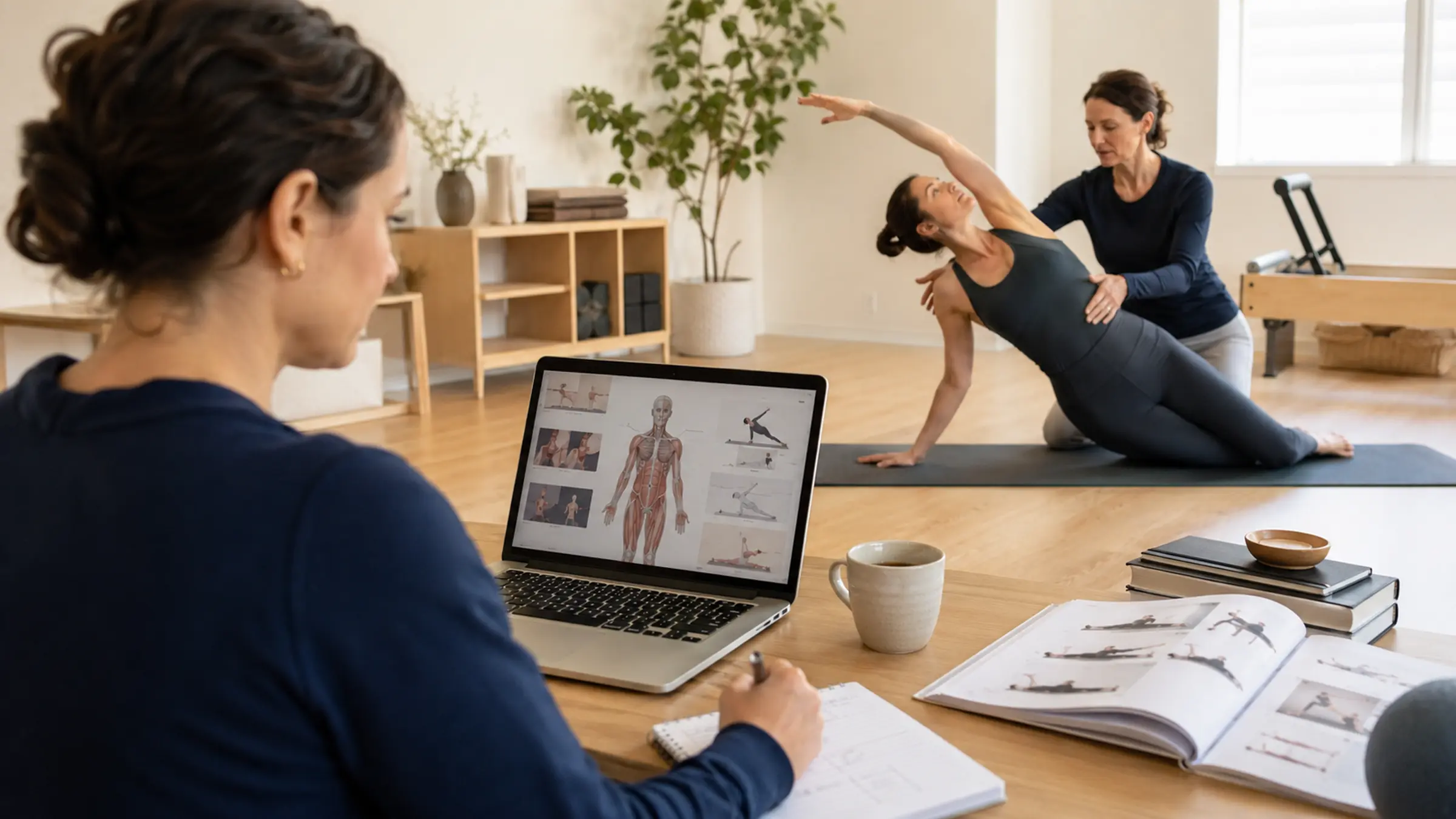
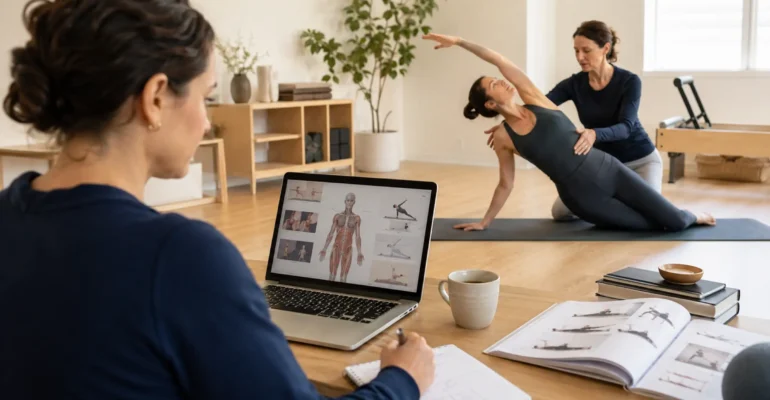
An online Pilates certificate can be a practical route into professional development, but the delivery format is only one part of the decision. The more important question is whether the programme teaches you to understand, select, adapt and communicate movement safely rather than simply memorise an exercise sequence.
Before choosing any Pilates instructor course, look beyond the word “online” and examine the curriculum, assessment, tutor expertise, practical expectations and the type of certificate being awarded.
1. A clear academic foundation
Pilates teaching involves more than demonstrating exercises. An instructor should understand the main joint actions involved in a movement, the muscles contributing to the task, the role of stabilisation, and how changes in range, lever length, resistance and body position alter the exercise.
A credible programme should therefore connect practical repertoire with applied anatomy, kinesiology, exercise physiology and biomechanics. This is particularly important in Reformer work, where spring resistance can assist one phase of a movement and resist another.
2. Practical teaching, not just video watching
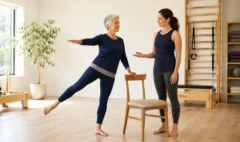
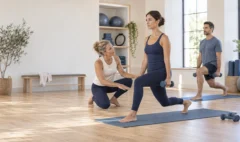
Online education can make demonstrations easier to replay and analyse, but watching a video does not by itself establish teaching competence. Learners still need to practise the movements, rehearse cueing, observe technique and develop the ability to modify exercises for different people.
When comparing courses, ask how practical competence is developed and assessed. A course should make clear what the learner is expected to demonstrate, not simply how many hours of video are available.
3. Progressions, regressions and safety decisions
A useful instructor course should teach more than a fixed repertoire. It should explain how to make an exercise easier or more demanding and why that change is appropriate. This may involve altering range of motion, base of support, resistance, tempo, equipment setup or the complexity of the task.
It should also address screening, contraindications, red flags and professional scope. Pilates instructors are exercise professionals, not substitutes for clinical assessment. When a participant presents with symptoms or a condition outside the instructor’s scope, referral to an appropriate healthcare professional is part of responsible practice.
4. Instructor expertise that is visible and verifiable
Look for named educators and clear information about who developed and teaches the academic and practical components. Expertise should be demonstrated through relevant qualifications, professional experience, teaching history or published work rather than vague claims such as “industry-leading experts”.
At EFWA, theoretical modules and anatomical analysis are prepared by Dr Mert Eray Onen, who has taught anatomy and kinesiology at university level since 2004. Practical Pilates demonstrations are delivered by Melisa Arslan. You can read more about the academic approach on the About EFWA page.
5. A course structure that fits your intended practice
Your best starting point depends on what you want to teach:
- Mat Pilates: an equipment-light foundation covering mat repertoire, movement analysis, cueing and adaptation.
- Reformer Pilates: adds equipment setup, spring resistance, Reformer-specific repertoire and apparatus safety.
- Pregnancy Pilates: focuses on physiological change, exercise adaptation and appropriate scope during pregnancy and the postnatal period.
- Pilates for Kids: requires age-appropriate programming, developmental considerations and safeguarding awareness.
EFWA also offers a Master Pilates pathway combining all four areas. Compare the current curriculum, study format and prices on the Online Pilates Instructor Courses page.
6. Transparent assessment, access and support
Before paying, confirm how long you can access the material, how assessments work, whether retakes are available, how questions are answered and what equipment is required. These practical details affect the learning experience far more than marketing slogans.
EFWA programmes use online knowledge assessments and programme-specific practical requirements, with tutor support through the course Q&A. The exact requirements are stated on the relevant course page and in the Learner FAQ.
Checklist before you buy an online Pilates instructor course
- Read the full curriculum rather than relying on the course title.
- Check who teaches anatomy, biomechanics and practical repertoire.
- Confirm how practical competence is developed and assessed.
- Check whether progressions, regressions, screening and scope are taught.
- Verify exactly what certificate or qualification is awarded.
- Ask any intended employer, studio or insurer about its own requirements.
- Review access duration, tutor support, assessment rules and refund terms.
- Compare the total learning value, not only the advertised course duration.
A practical assessment should test decisions, not recall alone
For EFWA, a useful practical assessment asks whether a learner can turn knowledge into a responsible teaching decision. The following five-part check is an EFWA educational framework, not an externally established standard:
| Capability | What credible evidence might look like |
|---|---|
| Explain | Describe the aim of an exercise in clear language without unsupported therapeutic claims. |
| Demonstrate | Show an organised version of the movement while keeping the intended task visible. |
| Observe | Notice relevant changes in control, breathing, comfort and task execution rather than searching for one “perfect” shape. |
| Adapt | Change range, support, resistance, tempo or complexity for a stated reason. |
| Review | Use learner feedback and observed response to decide whether to continue, regress, progress or refer. |
A course does not need to use these exact labels, but it should make practical competence inspectable. If every learner can pass by watching videos and answering recall questions, the assessment may reveal little about their ability to teach.
Why EFWA takes an anatomy-led approach
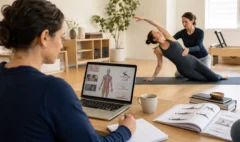
EFWA’s practical demonstrations are designed to show what is happening inside the body while an exercise is performed. Anatomical panels identify the joints involved, the movement at each joint, the muscles producing the movement, stabilising actions and the tissues being lengthened. The aim is to turn an exercise library into a teaching framework.
If you are deciding where to begin, read What Is Pilates? for a concise evidence-informed introduction, then compare Mat Pilates and Reformer Pilates training.
Frequently asked questions
Can I become a Pilates instructor through an online course?
Online study can deliver theory, demonstrations, movement analysis and assessment, but competent teaching still requires deliberate practical practice. Whether a particular certificate is accepted depends on the employer, studio, insurer or jurisdiction in which you intend to work.
Is a longer course automatically better?
No. Contact hours alone do not demonstrate curriculum quality. Look at what is actually taught, the level of practical engagement, assessment quality, educator expertise and whether the programme develops decision-making rather than simply presenting more content.
Should I choose Mat or Reformer first?
Mat Pilates is a useful foundation because it develops movement control without relying on large apparatus. Reformer training is appropriate when you intend to teach with the equipment and have access to a Reformer for practice. Your existing experience and intended teaching environment should guide the choice.