Can Pilates Improve Balance in Older Adults? Evidence and Teaching Implications

EFWA Pilates Knowledge
Can Pilates Improve Balance in Older Adults? Evidence and Teaching Implications
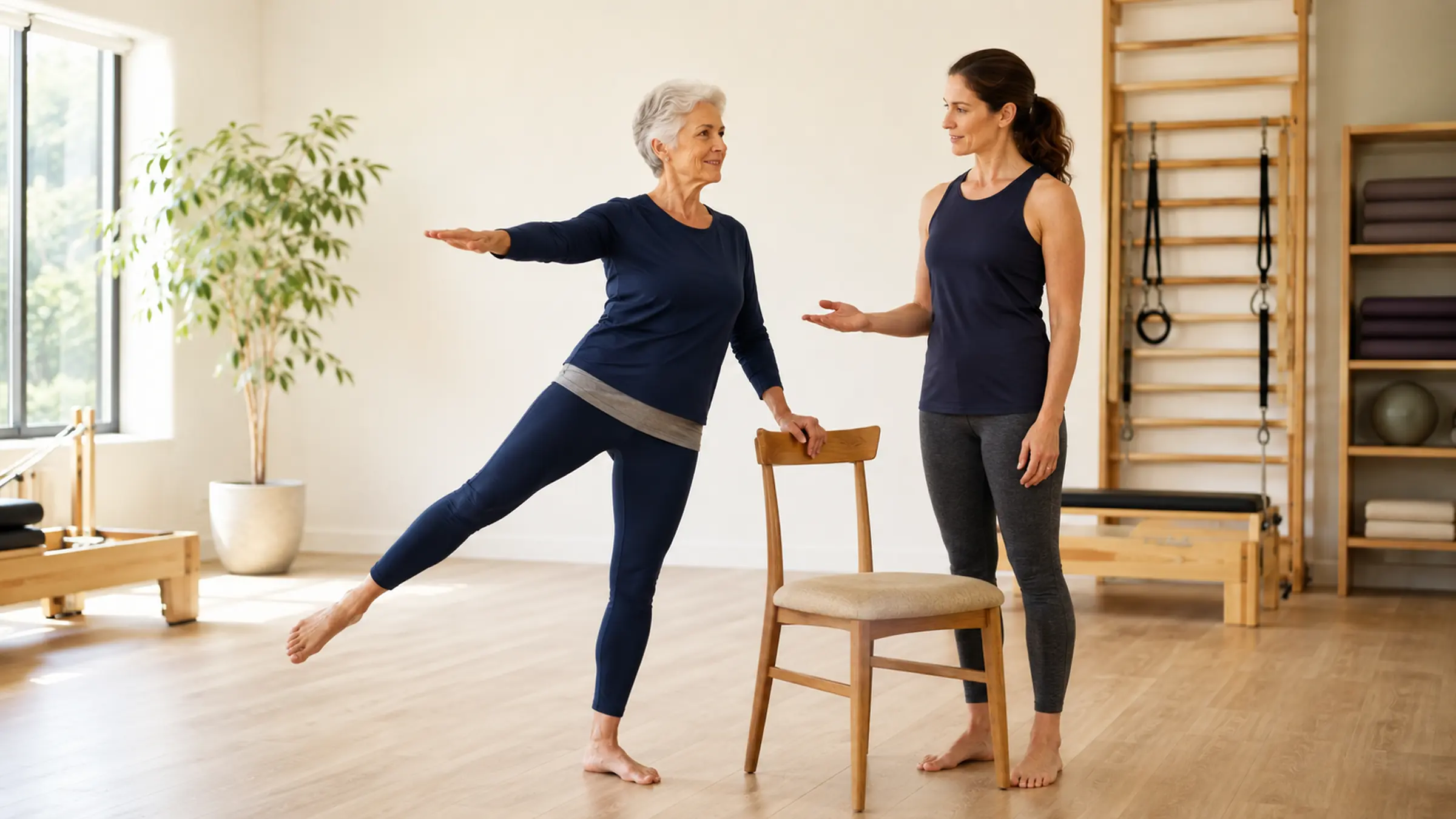
Direct answer: Pilates may improve measured balance and aspects of physical function in some older adults, particularly when compared with no structured exercise. That is useful evidence, but it does not prove that Pilates prevents falls. Balance tests, fall-risk scores and the number of falls are related outcomes—not interchangeable ones.
What the strongest reviews suggest
A 2021 systematic review and meta-analysis included 39 randomised trials involving adults aged 60 and over. Compared with inactive or usual-activity control groups, Pilates produced favourable average effects for balance, strength, flexibility and function. The authors rated certainty as low for balance, flexibility and function, and moderate for strength and fall-risk outcomes.
A 2023 review focused specifically on balance and also reported favourable findings for static and dynamic balance. Results were not uniform across every intervention, and the static-balance analysis showed some heterogeneity. Together, these reviews support a cautious statement: Pilates may be a useful way to train balance-related capacity in selected older adults.
A 2024 systematic review and meta-analysis sharpened this conclusion by separating balance measures from actual fall events. It found improvements in static and dynamic postural balance, but not in the number of falls or fear of falling. A class may therefore improve a laboratory or functional test without yet having evidence that it prevents falls.
Why “better balance” does not equal “fewer falls”
Many studies use performance tests—such as standing balance, functional mobility or composite risk scores—because actual falls require longer follow-up and careful recording. A better score may indicate improved capacity, but it cannot by itself confirm that fewer falls occurred.
A separate 2021 systematic review found improvements in some fall-risk factors but highlighted the lack of high-quality evidence that Pilates reduces actual falls. This distinction matters in public communication. “Pilates can prevent falls” is a stronger claim than the current evidence can support.
Falls are also influenced by medication, vision, footwear, home hazards, illness, cognition and previous falls. One class format cannot manage this whole risk picture.
What broader fall-prevention research adds
Pilates-specific findings sit inside a much larger fall-prevention literature. An abridged Cochrane review found that exercise reduced the rate of falls by 23% in community-dwelling older adults; programmes centred on balance and functional exercise reduced it by 24%. These figures should not be transferred automatically to every Pilates class. They show that programme content—not the method’s name—matters.
The World Falls Guidelines recommend individualised, progressively challenging balance and functional exercises, including stepping and sit-to-stand tasks, delivered at an effective dose. A mainly supported mat session may still be useful, but it should not be marketed as a complete fall-prevention programme unless its tasks, progression and dose justify that claim.
Practical application for instructors
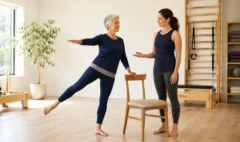
Established principle: balance improves when participants practise tasks that genuinely challenge balance at an appropriate level. A session composed almost entirely of supported, lying exercises should not automatically be described as a complete balance programme.
EFWA expert interpretation: Pilates instructors can make their contribution clearer by planning across several movement demands:
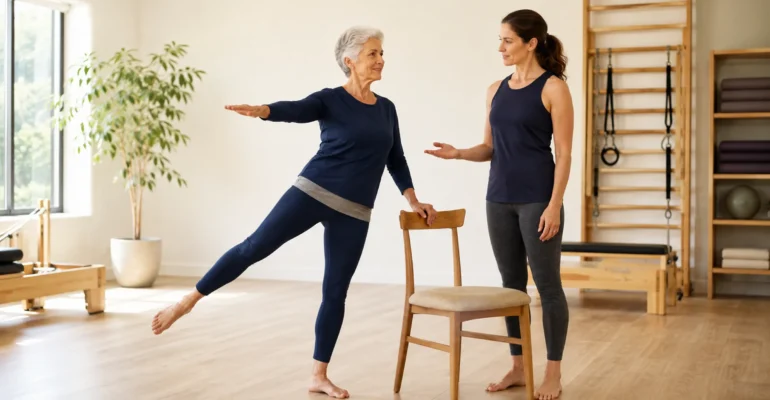
- Base of support: progress from wider, well-supported positions towards narrower or less supported positions when appropriate.
- Weight transfer: include controlled shifts forwards, backwards and sideways rather than training in one plane only.
- Transitions: practise getting down, up, turning and changing direction where the participant can do so safely.
- Sensory conditions: vary visual focus, surface feedback or hand support carefully; remove support only when a reliable alternative is available.
- Strength contribution: include progressive lower-limb loading, while recognising that Pilates should not automatically be assumed to deliver every element of a complete strength programme.
- Meaningful progression: change one variable at a time and record how the participant responds.
When a class is only one part of the answer
The World Falls Guidelines recommend targeted exercise or physiotherapy for intermediate risk and comprehensive multifactorial assessment for high risk. A Pilates instructor should not attempt to reproduce a clinical falls assessment. Recurrent falls, fall-related injury, unexplained dizziness or loss of consciousness, a material change in walking or balance, or fear that substantially restricts activity should trigger appropriate referral or coordination.
For higher-risk participants, exercise may need to sit alongside review of medicines, vision, cardiovascular or neurological factors and the home environment.
Balance is not the same as strength
Evidence for balance should not be stretched into claims about every fitness component. A 2024 review concluded that current evidence was insufficient to recommend Pilates specifically for improving strength, muscular endurance or power in older adults. If strength is a programme goal, instructors should verify that suitable lower-limb loading and progression are present rather than assuming that the Pilates label supplies them.
How Pilates fits a broader activity plan
Pilates may contribute to balance, strength, mobility and confidence, depending on programme design. Current UK Chief Medical Officers’ guidance treats aerobic activity, muscle strengthening and balance as complementary parts of an older adult’s activity plan. The exact programme should still suit the person’s health, goals and abilities. Pilates can be one component without being presented as the only necessary component.
Progressing balance without assuming transfer
Balance is task-specific. An improvement in one controlled test or Pilates exercise may not transfer automatically to rapid stepping, uneven ground or everyday fall avoidance. EFWA therefore recommends progressing the demand you can describe and observe.
| Variable | Example progression | Teaching check |
|---|---|---|
| Hand support | Firm support → light fingertip support → hands free | Remove support only when the participant can recover control without rushing or holding their breath. |
| Base of support | Comfortable stance → narrower stance → staggered or single-leg emphasis | Keep a stable support option within reach and change one constraint at a time. |
| Movement | Static hold → controlled arm or leg movement → direction change | Preserve the intended quality rather than rewarding longer duration at any cost. |
| Attention | Single task → simple cue response or light dual task | Do not add cognitive complexity when it compromises safe task control. |
A sensible session can include supported standing, controlled weight shift and stepping practice alongside Mat or apparatus work, but the selection should reflect the learner’s capacity and environment. Pilates may contribute to a broader activity plan; it should not be presented as a universal substitute for all components of fall-prevention exercise.
Evidence limitations
Programmes vary in format, dose, supervision and participant health. Many studies are small, and inactive control groups can make any structured activity appear more favourable. The evidence is stronger for changes in measured balance than for actual fall incidence. Results from healthy volunteers should not be generalised to frail adults or people with complex medical needs.
Continue learning
EFWA’s Academic Team connects exercise science with responsible professional practice. Students and instructors can also compare EFWA’s Pilates education pathways for further study.
This article is an evidence-informed educational overview, not an individual falls assessment or clinical recommendation.
Author disclosure: Dr Onen is EFWA’s Founder and Academic Director. EFWA provides Pilates education.

Related reading
References
- da Silva, L. D., Shiel, A., & McIntosh, C. (2021). Pilates reducing falls risk factors in healthy older adults: A systematic review and meta-analysis. Frontiers in Medicine, 8, 708883. https://doi.org/10.3389/fmed.2021.708883
- de Campos Júnior, J. F., de Oliveira, L. C., dos Reis, A. L., de Almeida, L. I. M., Branco, L. V., & de Oliveira, R. G. (2024). Effects of Pilates exercises on postural balance and reduced risk of falls in older adults: A systematic review and meta-analysis. Complementary Therapies in Clinical Practice, 57, 101888. https://doi.org/10.1016/j.ctcp.2024.101888
- Fernández-Rodríguez, R., Álvarez-Bueno, C., Ferri-Morales, A., Torres-Costoso, A., Pozuelo-Carrascosa, D. P., & Martínez-Vizcaíno, V. (2021). Pilates improves physical performance and decreases risk of falls in older adults: A systematic review and meta-analysis. Physiotherapy, 112, 163–177. https://doi.org/10.1016/j.physio.2021.05.008
- Oliveira, L. S., de Oliveira, R. G., da Silva, T. Q., Gonzaga, S., & de Oliveira, L. C. (2024). Effects of Pilates exercises on strength, endurance and muscle power in older adults: Systematic review and meta-analysis. Journal of Bodywork and Movement Therapies, 39, 615–634. https://doi.org/10.1016/j.jbmt.2024.02.021
- Montero-Odasso, M., van der Velde, N., Martin, F. C., Petrovic, M., Tan, M. P., Ryg, J., Aguilar-Navarro, S., Alexander, N. B., Becker, C., Blain, H., Bourke, R., Cameron, I. D., Camicioli, R., Clemens Becker, C., Close, J., Delbaere, K., Duan, L., Duque, G., Dyer, S. M., … Task Force on Global Guidelines for Falls in Older Adults. (2022). World guidelines for falls prevention and management for older adults: A global initiative. Age and Ageing, 51(9), afac205. https://doi.org/10.1093/ageing/afac205
- Sherrington, C., Fairhall, N., Wallbank, G., Tiedemann, A., Michaleff, Z. A., Howard, K., Clemson, L., Hopewell, S., & Lamb, S. (2020). Exercise for preventing falls in older people living in the community: An abridged Cochrane systematic review. British Journal of Sports Medicine, 54(15), 885–891. https://doi.org/10.1136/bjsports-2019-101512
- Sampaio, T., Encarnação, S., Santos, O., Narciso, D., Oliveira, J. P., Teixeira, J. E., Forte, P., Morais, J. E., Vasques, C., & Monteiro, A. M. (2023). The effectiveness of Pilates training interventions on older adults’ balance: A systematic review and meta-analysis of randomized controlled trials. Healthcare, 11(23), 3083. https://doi.org/10.3390/healthcare11233083
- Department of Health and Social Care. (2026, July 10). UK Chief Medical Officers’ physical activity guidelines. GOV.UK. Physical activity guidelines