Why Did the Scale Go Up Overnight? Reading Weight Trends Without Panic

Why Did the Scale Go Up Overnight? Reading Weight Trends Without Panic
Estimated reading time: 6 minutes
By Dr Mert Eray Onen, Founder & Academic Director, EFWA · ORCID 0000-0001-8510-7293
An overnight rise on the scale does not, by itself, show that body fat has increased. A scale measures total body mass. Water, stored carbohydrate, food and drink still in the digestive tract, and the timing of the measurement can all change that number without identifying how much fat, if any, has changed. A single reading is useful information, but it is a poor verdict on yesterday’s choices.
Someone following a steady eating and activity plan may see a lower reading on Monday and a higher one on Tuesday. It is tempting to respond by eating much less or adding a punishing workout. That reaction confuses a measurement with an explanation. The first question is whether the two measurements are comparable; the second is what the longer trend shows.
What a bathroom scale actually measures
Body mass is the combined weight of many tissues and substances. Fat mass is one component, but muscle, bone, organs, blood, water and material moving through the digestive system also contribute. The scale does not label those components. Even if a device reports “body fat” or “muscle”, those figures are estimates from a model, rather than direct measurements of tissue gained or lost overnight.
Stored carbohydrate illustrates the problem. Glycogen is held with water. Changes in carbohydrate availability can therefore move body mass relatively quickly without representing an equal change in fat. An early fall in scale weight during a restrictive diet, or a rise after returning to a more usual intake, should not automatically be described as fat loss or fat regain. Kreitzman and colleagues (1992) demonstrated the potential for glycogen and associated water to distort interpretations of short-term weight change.
The menstrual cycle can add another source of variation for some people. In a study of 42 women measured twice weekly (Kanellakis et al., 2023), average weight was about 0.45 kg higher during menstruation than during the first week of the cycle, alongside a similar change in extracellular water. That is a group average from one study, not a correction to apply to every individual or every cycle.
Make comparisons fair before interpreting them
NHS England (2023) advises using the same scale consistently, preferably in the morning, at regular intervals. The aim is to reduce avoidable noise: different clothing, an evening measurement after meals, or moving the scale to a soft floor can make two readings less comparable. A practical routine is to weigh at a similar time, on a firm surface, with similar clothing and before breakfast when that suits the person.
Daily weighing is optional. NICE guidance gives weekly weighing as one example of monitoring and specifically warns about risks for people who have, or may develop, disordered eating (NICE, 2026). Choose a routine that fits the person and any existing care plan. Comparing this Saturday morning with last Saturday morning is more informative than comparing today’s morning reading with yesterday’s evening one.
There is no need to turn every number into a behavioural instruction. A rise after travel, a meal out or a harder training session can prompt a check of context, but the scale alone cannot establish why it happened. Avoid attaching blame to an uncertain measurement.
Does weighing more often improve weight loss?
A systematic review of randomised trials (Madigan et al., 2015, with its 2016 correction) found little evidence that advising self-weighing alone produced weight loss. Adding weighing and self-regulation to a broader behavioural programme was associated with a modest extra benefit, while programmes containing self-weighing outperformed minimal intervention. The review found no clear advantage for daily over weekly instructions. Its trials used different packages of support, so the number on the scale cannot be credited with the whole effect.
Tracking is useful when it supports a workable plan. A separate meta-analysis found mostly no adverse psychological associations overall, but a small negative association with psychological functioning and differences between populations and study designs (Benn et al., 2016). Those averages do not establish that weighing suits everyone. Ask whether the feedback helps the person, rather than treating more measurements as greater commitment.
Before changing the plan
EFWA educational position: the following questions can guide a conversation about weight data. They are not a diagnostic test, a prescribed weighing frequency or a claim that three measurements are enough.
1. Check the conditions
Was the scale, time of day, clothing and surface similar? If not, record the result without comparing it too strongly with the previous one. Note obvious contextual changes such as travel or the stage of a menstrual cycle, but do not assume they fully explain the result.
2. Check the series
Look across several comparable readings rather than choosing the highest or lowest. A line moving gradually over weeks conveys more about direction than a one-day jump. The precise number of readings needed depends on the person’s goal, measurement frequency and circumstances; this is a judgement about signal and noise, not a universal formula.
3. Check the response
Ask what a proposed adjustment is meant to improve. If the longer trend, habits and wellbeing all support the current plan, an isolated increase may call for no change. If the trend is persistently different from the agreed goal, review the full plan with the relevant professional rather than prescribing an abrupt food or exercise restriction from one reading.
In a hypothetical example, a client records 78.4 kg on Friday and 79.1 kg on Saturday after a different meal pattern. One cannot infer that 0.7 kg of fat appeared overnight. For a client who feels well and has no concerning symptoms, the trainer checks the measurement conditions and reviews the wider pattern before suggesting a change. If the client is already anxious about weighing, the conversation may focus on strength, function and sustainable habits instead.
What about smart scales and “body-fat percentage”?
Many home body-composition scales use bioelectrical impedance. A crossover pilot study of 18 healthy adults found changes in estimated body compartments over time after different fluids, although the authors considered the differences likely clinically insignificant (Schierbauer et al., 2023). It supports consistent measurement conditions, not claims that drinking water necessarily produces a large measurement error. A displayed change is not direct evidence that muscle or fat tissue changed overnight.
More decimal places do not solve an interpretation problem. If body composition is clinically important, the method and its interpretation belong with an appropriately qualified professional.
Evidence limits and professional scope
Research on self-weighing often combines it with counselling, goal setting or feedback, making the isolated effect uncertain. The menstrual-cycle study was modest in size and does not describe every person’s pattern. Hydration studies of bioimpedance examine measurement behaviour, not whether a specific home scale accurately tracks an individual over months. These findings support careful interpretation, not a guarantee that any particular rise is harmless or water-related.
Fitness and movement professionals can help clients compare measurements fairly and keep attention on agreed behaviours and functional outcomes. They should not diagnose unexplained rapid weight change, eating disorders, fluid-retention conditions or medication effects. A client with concerning symptoms or persistent, unexplained change needs appropriate healthcare assessment. If weighing itself fuels distress or compulsive restriction, prioritise wellbeing and refer to qualified support.
When reviewing a longer-term plan, our guide to preserving muscle during weight loss considers outcomes beyond the scale. Explore the Nutrition & Weight Management articles for related learning. For those developing coaching skills, EFWA’s personal trainer courses explain the available study routes.
References
- Benn, Y., Webb, T. L., Chang, B. P. I., & Harkin, B. (2016). What is the psychological impact of self-weighing? A meta-analysis. Health Psychology Review, 10(2), 187–203. https://doi.org/10.1080/17437199.2016.1138871
- Kanellakis, S., Skoufas, E., Simitsopoulou, E., Migdanis, A., Migdanis, I., Prelorentzou, T., Louka, A., Moschonis, G., Bountouvi, E., & Androutsos, O. (2023). Changes in body weight and body composition during the menstrual cycle. American Journal of Human Biology, 35(11), Article e23951. https://doi.org/10.1002/ajhb.23951
- Kreitzman, S. N., Coxon, A. Y., & Szaz, K. F. (1992). Glycogen storage: Illusions of easy weight loss, excessive weight regain, and distortions in estimates of body composition. The American Journal of Clinical Nutrition, 56(1 Suppl), 292S–293S. https://doi.org/10.1093/ajcn/56.1.292S
- Madigan, C. D., Daley, A. J., Lewis, A. L., Aveyard, P., & Jolly, K. (2015). Is self-weighing an effective tool for weight loss: A systematic literature review and meta-analysis. International Journal of Behavioral Nutrition and Physical Activity, 12, Article 104. https://doi.org/10.1186/s12966-015-0267-4
- Madigan, C. D., Daley, A. J., Lewis, A. L., Aveyard, P., & Jolly, K. (2016). Erratum to: Is self-weighing an effective tool for weight loss: A systematic literature review and meta-analysis. International Journal of Behavioral Nutrition and Physical Activity, 13, Article 42. https://doi.org/10.1186/s12966-016-0366-x
- National Institute for Health and Care Excellence. (2026). Overweight and obesity management (NICE Guideline NG246; updated January 8, 2026), recommendation 1.3.3. https://www.nice.org.uk/guidance/ng246/chapter/Preventing-overweight-obesity-and-central-adiposity
- NHS England. (2023, December 1). How to record your weight. https://www.england.nhs.uk/long-read/how-to-record-your-weight/
- Schierbauer, J., Günther, S., Haupt, S., Zimmer, R. T., Herz, D., Voit, T., Zimmermann, P., Wachsmuth, N. B., Aberer, F., & Moser, O. (2023). Acute fluid intake impacts assessment of body composition via bioelectrical impedance analysis. A randomized, controlled crossover pilot trial. Metabolites, 13(4), Article 473. https://doi.org/10.3390/metabo13040473
This article provides general professional education and is not medical advice or an individual nutrition prescription.
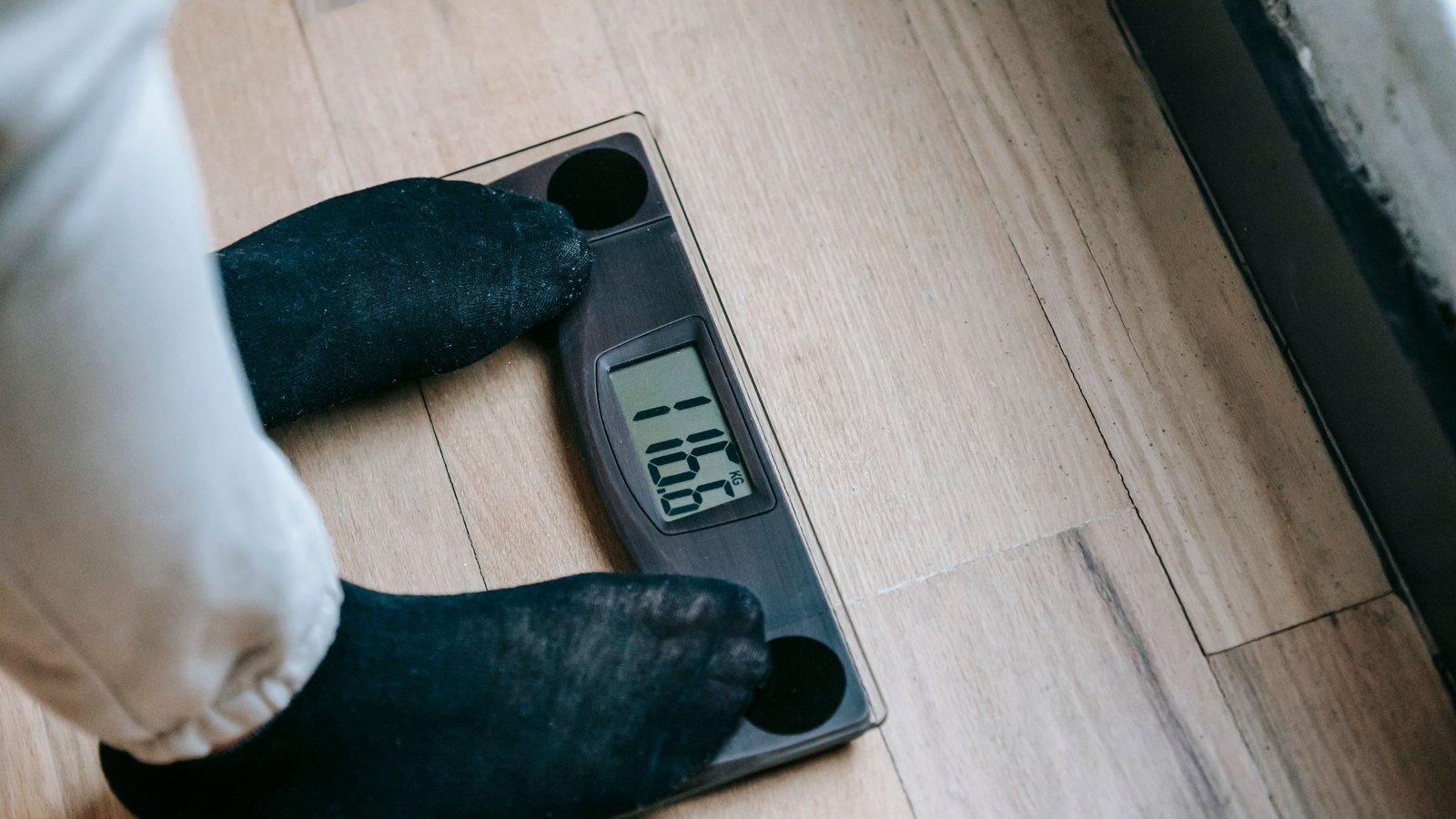
Photo: Andres Ayrton / Pexels, used under the Pexels licence. Illustrative photograph; the displayed number is not a target or a client record.