Can You Build Muscle with Plant Protein?


By Dr Mert Eray Onen
Estimated reading time: 6 minutes
Yes. A well-planned plant-based diet can support gains in muscle and strength alongside resistance training. That does not mean every plant protein has been shown to perform identically to every animal protein, or that replacing meat with any vegan-labelled product preserves a meal’s nutritional contribution. The useful question is whether the diet supplies enough protein and energy to support the training being done—not which side wins a plant-versus-animal argument. (Hevia-Larraín et al., 2021; BDA, 2026)
For instructors and learners, this distinction matters. Someone who wants to eat fewer animal foods needs a workable way to assess meals, not a demand to abandon their preferences or buy a particular powder.
Why the latest reviews do not give one simple verdict
A 2025 systematic review found a small overall advantage for animal protein for muscle mass. However, the comparison changed when protein sources were separated: soy and milk protein did not differ detectably, while the smaller evidence base for non-soy plant proteins favoured animal protein. Pooled strength results did not show a significant difference. “Plant protein” is therefore too broad a label to explain the findings on its own. (Reid-McCann et al., 2025)
A newer review, published on 1 April 2026, examined supplementation trials lasting at least six months. It found no statistically significant differences in pooled lean-body-mass or strength outcomes. Most plant interventions involved soy, however, and the participants and study purposes were not limited to people training specifically for muscle growth. These findings do not establish that all foods, powders and training contexts are interchangeable. (Yimam et al., 2026)
The reviews ask overlapping but different questions. Their inclusion criteria and outcomes differ. A non-significant result is not proof of exact equivalence, just as a small average difference is not a forecast of what will happen to one person.
What happens during an actual training programme?
In a 12-week study, habitual vegans and omnivores completed supervised resistance training with matched protein intakes, supported by soy or whey supplements respectively. Both groups gained muscle and strength, without a significant difference between groups. Crucially, participants were young men, and their habitual diets were not randomly assigned. The study demonstrates that progress on a plant-based diet is possible under those conditions; it is not a universal comparison of unsupplemented diets. (Hevia-Larraín et al., 2021)
A separate review of plant-based dietary patterns and strength also found no significant pooled disadvantage. Its evidence base contained only eight trials and 188 participants. Strength and muscle size are related outcomes, but they are not the same measurement. (López-Moreno et al., 2025)
Start with the meal being replaced
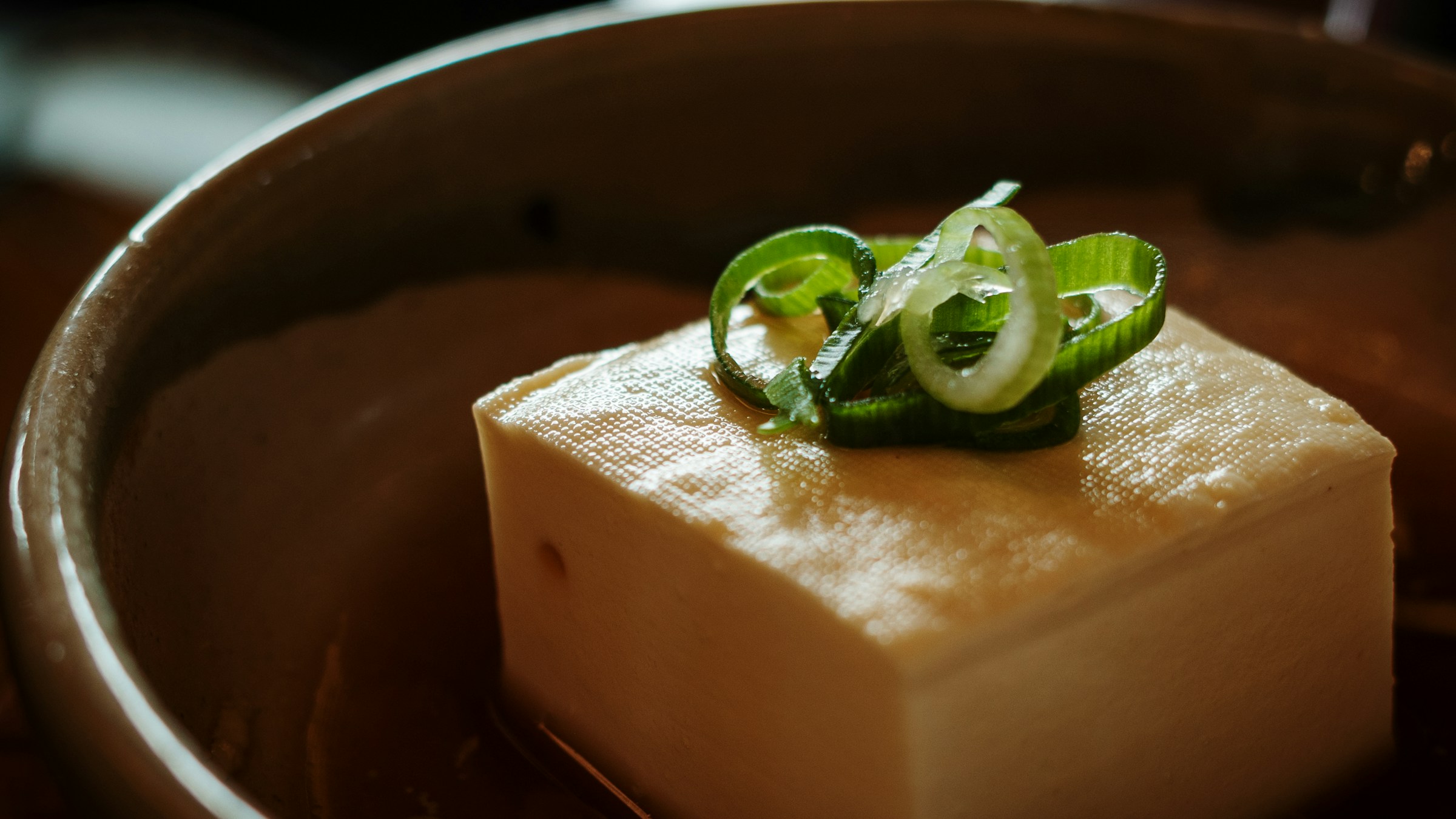
The BDA identifies beans, lentils, chickpeas, tofu, tempeh, nuts and seeds among useful plant protein sources. A food’s role still depends on the portion and the rest of the meal. A sprinkle of seeds and a substantial serving of tofu should not be treated as automatically equivalent because both appear on a protein-food list. (BDA, 2021)
Here is an EFWA educational exercise: ask a learner to describe a familiar meal before and after a proposed swap. Keep the discussion descriptive rather than turning it into an individual prescription.
Original meal: chicken, rice and vegetables.
Proposed swap: remove the chicken and add more vegetables.
Question to explore: what now supplies the main protein contribution? Tofu, tempeh or a bean-based dish could be candidates, depending on preferences and the amount eaten. The point is to notice the missing role, not to declare one universal replacement portion.
Next, examine the packaging of the actual food being considered. Compare the protein information for the portion the learner would eat, rather than comparing one product’s “per serving” figure with another product’s “per 100 g” figure. This is a label-reading exercise, not a personalised protein target.
A useful conversation is about a whole training day
Protein is only part of sports nutrition. The BDA’s guidance, reviewed in May 2026, places it within an adequate, varied diet that also supports energy and carbohydrate needs. Increasing protein while overlooking the rest of the diet is not a complete training strategy. (BDA, 2026)
An instructor can make that discussion practical without prescribing a menu:
- Ask the learner to identify protein-containing foods in their usual breakfast, lunch and evening meal.
- Ask which options they genuinely enjoy, can afford and can prepare on a busy day.
- Ask whether the proposed changes are additions, replacements or the removal of substantial parts of meals.
- Identify questions requiring a registered dietitian rather than improvising a clinical nutrition plan.
These prompts are an EFWA teaching aid, not a validated dietary assessment. They help expose assumptions. “I eat plant-based” tells an instructor little about the meals actually eaten; “I have lentil soup at lunch and tofu with rice at dinner” provides something concrete to discuss.
The training side also needs its own attention. Our guide to progressive overload explains how to review the exercise stimulus. If weight loss is also a goal, use the separate guide to preserving muscle during weight loss rather than assuming that a source comparison answers questions about an energy deficit.
Avoid turning a research ingredient into a shopping rule
Soy isolates and concentrates appear frequently in the longer-term evidence. That makes the evidence more informative about those interventions than about every pea, rice, bean or mixed-food product. It does not create a requirement for every plant-based exerciser to purchase soy powder. (Yimam et al., 2026)
EFWA’s educational position is to establish the question before discussing a product. Is the learner asking about meal planning, convenience, taste, a dietary restriction or an apparent lack of training progress? Those are different conversations. A supplement brand should not become the answer before the underlying question is clear.
Evidence limitations and professional boundaries
The evidence is uneven across protein sources, ages and training backgrounds. Supplement comparisons do not automatically describe whole diets, and lean-mass measurements should not be read as identical to direct measurements of muscle growth. The 2026 review also reports industry affiliations and publication support; that is relevant context, not grounds to dismiss its results without examining the methods. (Reid-McCann et al., 2025; Yimam et al., 2026)
A fully vegan diet requires attention beyond protein, including reliable vitamin B12 provision and other nutrients such as calcium, iodine and iron. The BDA’s plant-based factsheet offers a starting point, although it is currently marked as under review. Individual needs, suspected deficiency, restrictive eating or a medical condition warrant appropriately qualified nutritional or medical support. Fitness education is not a substitute for that assessment. (BDA, 2021)
The practical conclusion is encouraging but conditional: plant-based muscle building is a realistic option, and careful food choices matter. Help learners connect evidence to meals they will actually eat, while keeping personalised dietary treatment outside an instructor’s remit.
References
- British Dietetic Association. (2021, April). Vegetarian, vegan and plant-based diet. https://www.bda.uk.com/resource/vegetarian-vegan-plant-based-diet.html
- British Dietetic Association. (2026, May). Sport and exercise. https://www.bda.uk.com/resource/sport-exercise-nutrition.html
- Hevia-Larraín, V., Gualano, B., Longobardi, I., Gil, S., Fernandes, A. L., Costa, L. A. R., Pereira, R. M. R., Artioli, G. G., Phillips, S. M., & Roschel, H. (2021). High-protein plant-based diet versus a protein-matched omnivorous diet to support resistance training adaptations: A comparison between habitual vegans and omnivores. Sports Medicine, 51(6), 1317–1330. https://doi.org/10.1007/s40279-021-01434-9
- López-Moreno, M., Rossi, E. V., López-Gil, J. F., Marrero-Fernández, P., Roldán-Ruiz, A., & Bertotti, G. (2025). Are plant-based diets detrimental to muscular strength? A systematic review and meta-analysis of randomized controlled trials. Sports Medicine–Open, 11, Article 62. https://doi.org/10.1186/s40798-025-00852-7
- Reid-McCann, R. J., Brennan, S. F., Ward, N. A., Logan, D., McKinley, M. C., & McEvoy, C. T. (2025). Effect of plant versus animal protein on muscle mass, strength, physical performance, and sarcopenia: A systematic review and meta-analysis of randomized controlled trials. Nutrition Reviews, 83(7), e1581–e1603. https://doi.org/10.1093/nutrit/nuae200
- Yimam, M. A., Roberts, J., O’Callaghan, A., Holwerda, A., Cassidy, Y., Luiking, Y., van Helvoort, A., & Muscaritoli, M. (2026). Long-term effects of plant vs. animal protein supplementation on body composition, muscle strength, physical performance, and cardiometabolic risk factors in adults: A systematic review and meta-analysis of randomized controlled trials. Frontiers in Nutrition, 13, Article 1813846. https://doi.org/10.3389/fnut.2026.1813846
Explore more evidence-informed reading in the EFWA Knowledge Hub and meet our Academic Team.
About the author
Dr Mert Eray Onen is EFWA’s Founder and Academic Director. His teaching connects exercise physiology, applied anatomy and training science with professional practice. Author profile · ORCID: 0000-0001-8510-7293