How Long Should You Hold a Yoga Pose? Match the Time to the Goal

EFWA KNOWLEDGE HUB · YOGA FOUNDATIONS
By Dr Mert Eray Onen, Founder & Academic Director, EFWA · ORCID 0000-0001-8510-7293
Estimated reading time: 6 minutes
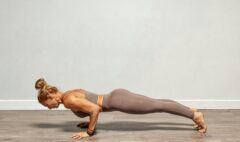
Direct answer: there is no single correct time for holding every yoga pose. A useful hold lasts long enough to serve the goal—learning, balance, strength, mobility or rest—without losing control, changing the intended movement or provoking an adverse response. “Five breaths” can be a teaching rhythm, but it is not a universal physiological dose.
Two classes may use the same posture differently. One may pass through it briefly in a flow; another may repeat it for balance practice; a third may sustain a supported version for comfort. The shape alone does not determine the training effect. Duration interacts with muscular effort, range, support, fatigue, breathing and what comes next.
Why a longer hold is not automatically better
As a hold continues, several things can change. A student may experience more stretch sensation, accumulate local muscular fatigue, adjust their balance strategy, slow their breathing or simply become better at tolerating the position. Those are different responses, not one general benefit called “deeper yoga”.
Stretching research helps explain part of the picture. A 2025 meta-analysis of 189 studies found that both single-session and repeated static stretching improved flexibility in adults. Average gains did not continue increasing indefinitely: the analysis found no additional benefit beyond a cumulative four minutes in one session or ten minutes per week. These values describe pooled stretching studies, not a prescription to hold every yoga posture for four minutes.
A second 2025 analysis found that improved range after repeated stretching was associated with both reduced stiffness and increased stretch tolerance, while fascicle length did not change significantly. More available range can therefore emerge through several mechanisms. Feeling more comfortable at an endpoint does not prove that a muscle has permanently lengthened.
Match the hold to the purpose
Learning and flowing
When the aim is to learn entry, alignment choices and exit, shorter repeated exposures can provide more useful practice than one exhausting hold. The teacher can observe the transition, offer one cue and let the student try again. In a flowing sequence, the duration should preserve coordination with the next movement rather than turn every posture into an endurance test.
Balance
A balance hold is valuable only while the student is practising the intended balance problem. Repeated toe taps, a collapsing support leg or breath-holding may show that the task has changed. Research on yoga programmes suggests that yoga can improve balance, but studies use varied styles, session lengths and tests. They do not establish one optimal hold time for all standing poses.
Strength and muscular endurance
A sustained posture can create an isometric demand, but time is only one loading variable. Joint position, lever length, external support, effort and proximity to fatigue also matter. Isometric-training evidence shows that adaptations depend on muscle length, intensity and intent. Simply extending a low-effort hold does not make it equivalent to progressive strength training.
If strength is the goal, select a posture that creates a meaningful but controllable effort, define a repeatable duration or quality target, and progress one variable at a time. EFWA’s article Does Yoga Count as Strength Training? explains how to judge the whole weekly programme.
Flexibility and range of motion
Longer static exposure can increase immediate range, but it may not be ideal immediately before a task that depends on maximal force or speed. A 2026 systematic review in athletes with high flexibility demands found that longer static stretching produced larger immediate flexibility changes, while performance effects tended to be less favourable than with shorter or dynamic approaches. Most included studies were low quality, so exact cut-offs should be treated cautiously.
For yoga teaching, the practical lesson is to separate mobility work from performance preparation. A longer supported hold may suit a range-of-motion segment. Before demanding balances or powerful transitions, a shorter exposure followed by active movement may better match the task.
Restorative practice
In a well-supported restorative posture, duration may be chosen for settling, comfort and attention rather than flexibility or strength. A longer time is useful only while support remains appropriate and the student can change or leave the position easily. Claims that a precise number of minutes treats a condition or produces a guaranteed physiological effect go beyond the evidence.
The EFWA TIME check
EFWA educational position: TIME is a teaching aid for selecting and reviewing hold duration. It is not a clinical prescription.
T — Target
Name the purpose of the hold: learn, balance, strengthen, explore range or rest. If the target is unclear, the duration is arbitrary.
I — Intensity
Observe muscular effort and stretch sensation separately. A long mild hold and a short demanding hold are not interchangeable.
M — Mechanics
Check whether the intended position remains recognisable. Props, stance width and range can be adjusted so that time is spent practising the target rather than compensating.
E — Exit quality
The student should be able to leave with control. If the exit is rushed, balance is lost or symptoms appear, the hold has probably outlasted its useful dose for that version.
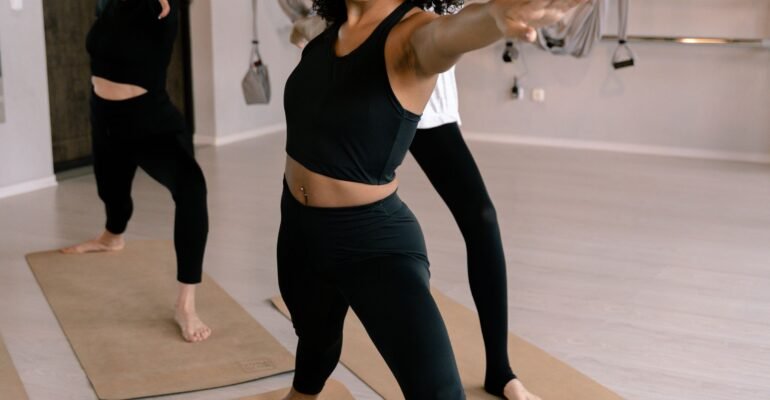
A worked example: Warrior II
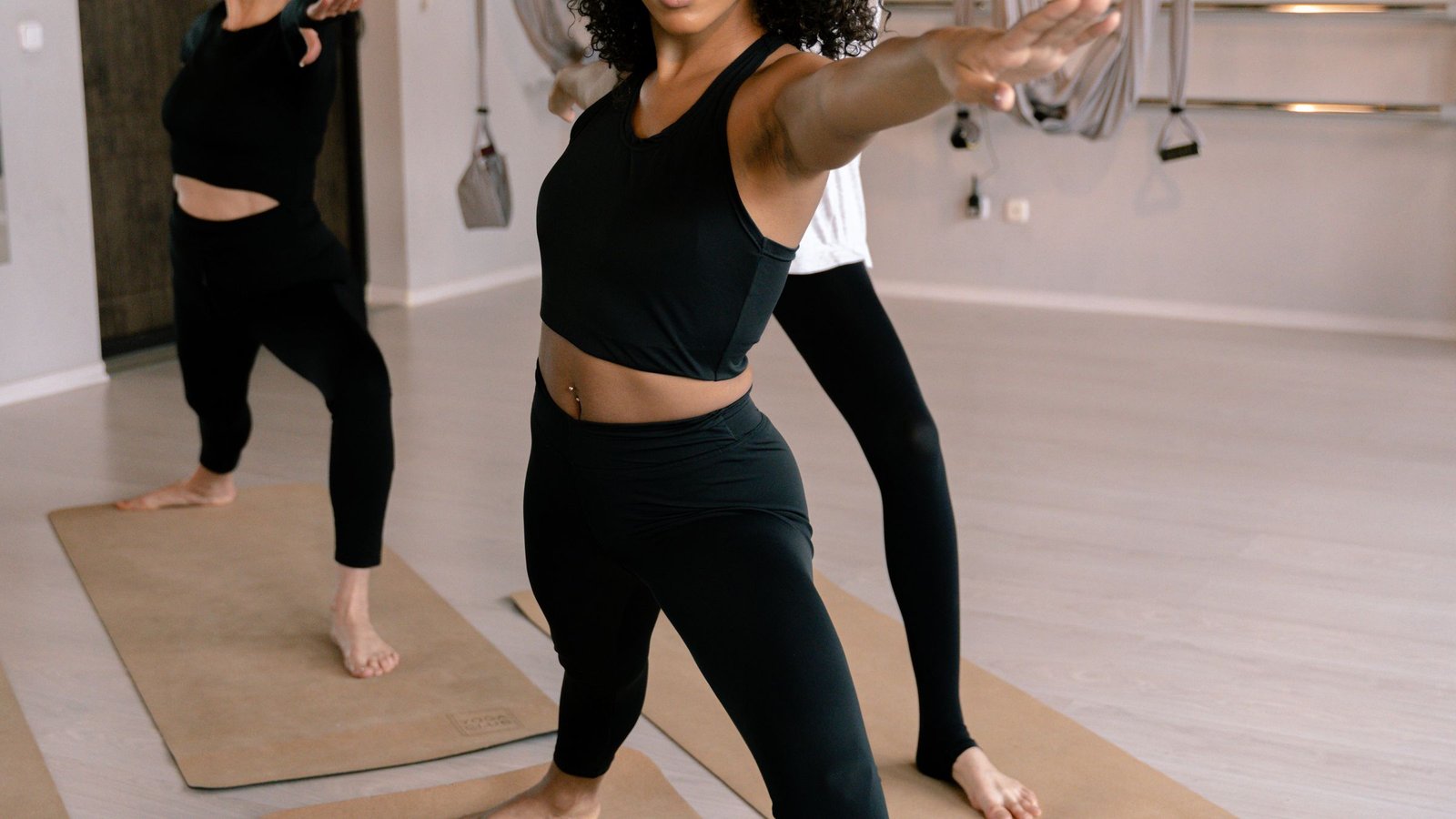
For a beginner learning Warrior II, the teacher might use several brief holds, each focused on one decision: stance, front-knee direction, trunk position and a controlled exit. The progress marker is clearer execution, not surviving a countdown.
For muscular endurance, the same posture can be adjusted to create a repeatable challenge. The teacher records the version and ends the hold while alignment and breathing remain controlled, then progresses gradually across sessions. For a mobility emphasis, a supported version may be held with less muscular demand, followed by active movement through the available range.
These are different exercises sharing a familiar shape. The hold time should reveal the intended quality, not obscure it.
What is established, emerging and interpretive?
- Established evidence: static stretching can increase range of motion, and sustained positions can create an isometric muscular demand.
- Emerging evidence: the balance between stretch tolerance, stiffness, muscle architecture and performance depends on dose, joint, task and population.
- EFWA educational position: choose hold time from the goal and stop at loss of useful quality; do not make a traditional breath count sound like a universal scientific rule.
Evidence limitations and professional scope
Very little research isolates the duration of one yoga posture while controlling all other class variables. Much of the evidence comes from laboratory stretching, isometric training or multi-week yoga programmes. It informs teaching decisions but cannot identify a perfect hold time for every asana, student or style.
Yoga instructors should not use hold tolerance to diagnose restriction, instability or injury. Pain, neurological symptoms, unexplained dizziness, loss of function or a new limitation warrants stopping and following an appropriate referral pathway. Individual medical or rehabilitation advice belongs with a suitably qualified clinician.
The practical takeaway
Do not start with a universal timer. Start with the purpose. Select a position and level of effort that match it, observe mechanics and finish while the exit remains controlled. Duration becomes meaningful only when it is connected to the task.
Continue with How Much Flexibility Do You Need for Yoga?, read about slow breathing in yoga, explore the EFWA Yoga Foundations Certificate, or visit the EFWA Knowledge Hub.
References
- Bajaj, P., Nagendra, L., Bajaj, A., Samuel, M., & Chandran, M. (2025). Effect of yoga on balance, falls, and bone metabolism: A systematic review of randomized controlled trials in healthy individuals. Osteoporosis International, 36(2), 193–224. https://doi.org/10.1007/s00198-024-07307-x
- Belli, I., Alghosi, M., Kalayeh, M. B., Abdollahzadeh, E., Heidari, F., Azar, R. A., Alimoradi, M., Iranmanesh, M., Hosseini, E., & Konrad, A. (2026). How long should athletes with high range of motion demands stretch? Acute stretching durations for flexibility and performance: A systematic review. Frontiers in Physiology, 17, 1881773. https://doi.org/10.3389/fphys.2026.1881773
- Ingram, L. A., Tomkinson, G. R., d’Unienville, N. M. A., Gower, B., Gleadhill, S., Boyle, T., & Bennett, H. (2025a). Mechanisms underlying range of motion improvements following acute and chronic static stretching: A systematic review, meta-analysis and multivariate meta-regression. Sports Medicine, 55(6), 1449–1466. https://doi.org/10.1007/s40279-025-02204-7
- Ingram, L. A., Tomkinson, G. R., d’Unienville, N. M. A., Gower, B., Gleadhill, S., Boyle, T., & Bennett, H. (2025b). Optimising the dose of static stretching to improve flexibility: A systematic review, meta-analysis and multivariate meta-regression. Sports Medicine, 55(3), 597–617. https://doi.org/10.1007/s40279-024-02143-9
- Oranchuk, D. J., Storey, A. G., Nelson, A. R., & Cronin, J. B. (2019). Isometric training and long-term adaptations: Effects of muscle length, intensity, and intent: A systematic review. Scandinavian Journal of Medicine & Science in Sports, 29(4), 484–503. https://doi.org/10.1111/sms.13375
This article provides general professional education and is not medical advice or an individual exercise prescription.
Author disclosure: Dr Onen is EFWA’s Founder and Academic Director. EFWA provides professional education in this subject area.