Neutral Spine in Pilates: When to Hold It and When to Move

Estimated reading time: 6 minutes
By Dr Mert Eray Onen, Founder & Academic Director, EFWA · ORCID 0000-0001-8510-7293
Neutral spine is a useful reference in Pilates, not a position to freeze. It can provide a starting point, especially when someone is learning to notice how the pelvis and trunk move. It is not one exact shape to hold through an entire class. Pilates also uses spinal flexion, extension and rotation. The useful question is whether the chosen position serves the exercise and the participant, with control and an appropriate range.
What does “neutral” mean in a class?
In practical teaching, neutral usually refers to a comfortable, middle-range arrangement of the pelvis and spine rather than a maximal tuck or maximal arch. It is a way of establishing a baseline. From that baseline, a person can intentionally change shape, then return to a familiar reference. Two participants may show different visible curves while both manage the task well.
This classroom meaning should not be confused with the biomechanical “neutral zone”, a term used in spinal stability research for a range of movement in which passive resistance is relatively low. Panjabi’s (1992) hypothesis concerns the behaviour of a spinal system; it does not provide an angle that an instructor can identify by sight and require in every exercise. Equating the two gives a technical term more authority than it has in a group class.
The spine’s shape also changes with position, movement and individual anatomy. An instructor can observe movement, ask about comfort and modify the task. A visual impression alone cannot diagnose an abnormal curve or determine whether a participant’s back is healthy.
Why a single “safe shape” is too strong a claim
An umbrella review of 41 systematic reviews (Swain et al., 2020) found no consensus that specific spinal postures or physical exposures cause low back pain. Some associations were reported, but evidence for causality was mixed. This does not prove that every posture, load or duration is equally suitable for every person. It means a blanket warning against all spinal flexion or all departures from neutral is not supported by that review.
A later meta-analysis (Sugavanam et al., 2025) comparing people with and without low back pain found only small differences in some static postural measures, with substantial variation between studies; it could not make firm conclusions about most lumbopelvic parameters. Static posture is only one piece of a complex picture. Neither review tested an instruction to hold neutral throughout a Pilates session, so applying it to that question is an informed teaching interpretation, not a direct trial result.
Pilates research also resists a simple “straight is better” message. A systematic review of Pilates and postural alignment (Roque et al., 2024) found some potential effects, but adult evidence was generally of very low to low certainty for several outcomes. A measurable change in an angle should not be advertised as a guaranteed correction, nor assumed to prevent pain or injury.
Neutral, imprint and movement have different jobs
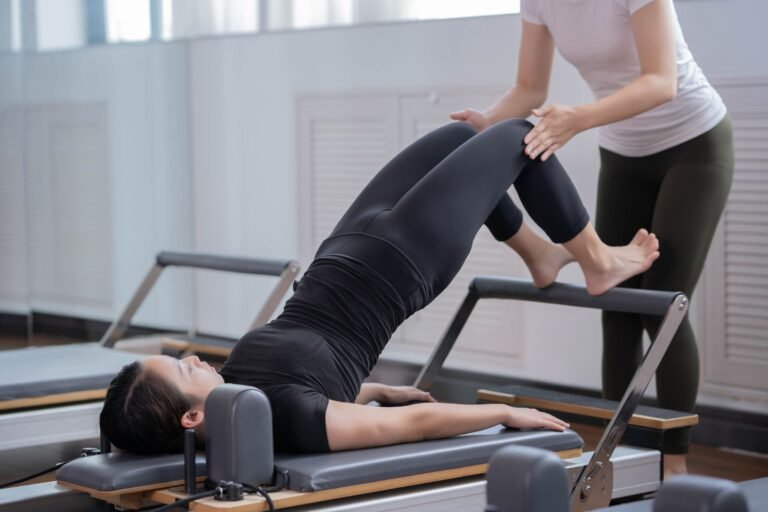
Consider a supine leg movement. An instructor may first ask the learner to explore a comfortable middle position and notice the contact of the pelvis with the mat. If moving the leg causes an unintended large shift, the instructor might shorten the lever, reduce range or slow the movement. In a different exercise, a small posterior pelvic tilt or spinal articulation may be the intended movement. Calling that “loss of neutral” misses the task.
Imprint is another deliberate strategy, often involving a posterior tilt and abdominal action. In a laboratory study of 26 experienced Pilates participants, imprint and several classic exercises increased abdominal muscle thickness measured with ultrasound, used as an indicator of activity (Endleman & Critchley, 2008). These results show that instructions and exercises can change muscle behaviour. They do not show that imprint is required for everyone, that neutral is ineffective, or that one position treats back pain.
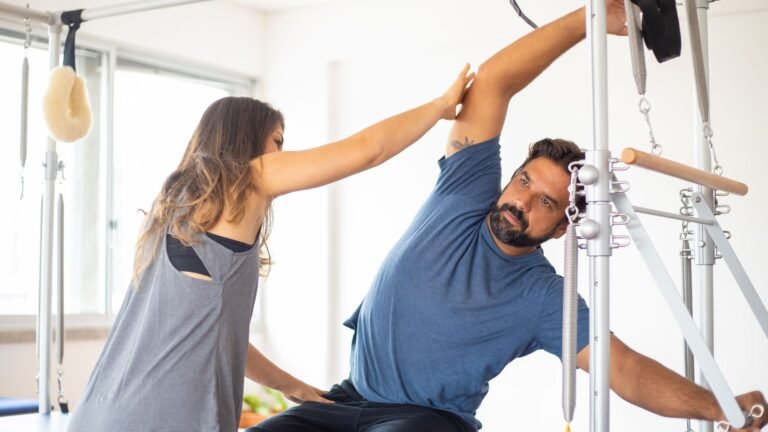
The same principle applies on apparatus. Springs, the moving carriage, body orientation and limb leverage alter the demand. A visible pelvic change may be part of a planned exercise, a sign that the current variation needs adjustment, or an individual variation whose significance is not clear from appearance alone. The instructor decides from the purpose of the movement and the participant’s response, not from a universal photograph of correct posture.
Three classroom situations that need different decisions
EFWA educational interpretation: these examples show how to match spinal position to a teaching goal. They are options for general movement education, not a rehabilitation sequence or a test of spinal health.
A heel slide: keeping a reference while the leg moves
A participant lies on their back with knees bent and slides one heel away. The chosen task is to move the leg while keeping the pelvis reasonably steady. If the back arches progressively as the heel travels, shorten the slide and compare the result. That gives the learner something observable to practise. Repeatedly demanding a smaller gap under the back may only turn attention towards pressing into the mat.
Different teaching systems describe neutral and imprint somewhat differently. Merrithew’s pelvic-placement guidance distinguishes a natural lumbar curve from a small posterior tilt with lumbar flexion, and explicitly says that imprint need not press the entire lower back into the mat (Merrithew, n.d.). This is a named teaching approach, not proof that everyone should use identical pelvic landmarks or contact pressure.
A spinal articulation: movement is the task
Now imagine a familiar, appropriately selected movement in which the participant deliberately rounds and then returns through a comfortable range. Asking for neutral throughout would contradict that task. The instructor explains which part is intended to move and observes whether the person can begin, control and finish the movement. More range is not automatically the next goal; a smaller, clearer movement may better serve today’s lesson.
A kneeling reach: adapt the challenge before blaming posture
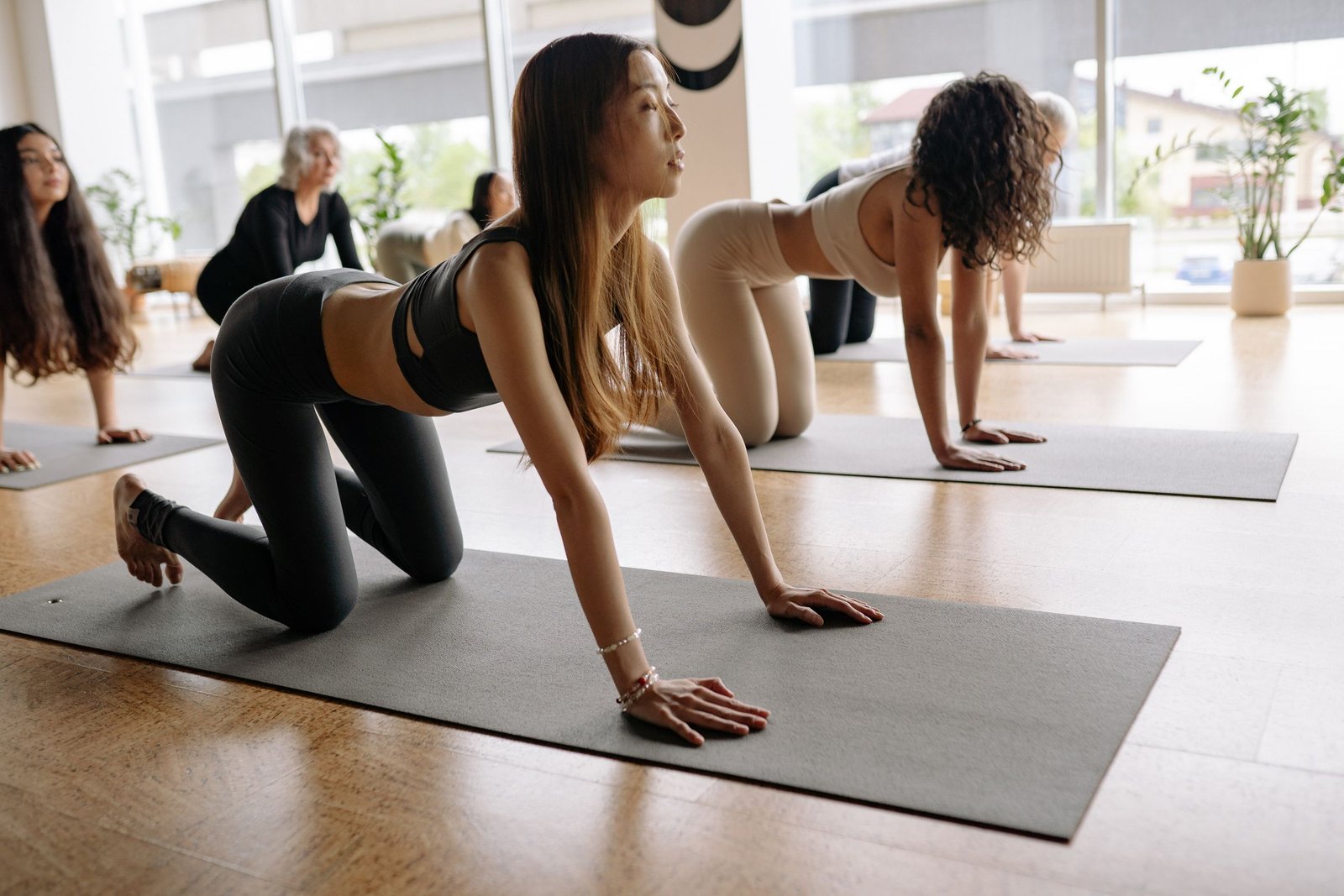
During an arm reach from hands and knees, the learner may shift the trunk more than intended. Try a shorter reach or keep the fingertips lightly supported while practising. Compare the response, rather than assuming that the visible shift proves a weak muscle or an unstable spine. Neutral can remain a helpful reference here without becoming a demand for perfect stillness.
These examples belong together because they teach a distinction: sometimes the aim is to resist movement, sometimes to produce it. Explain that distinction to the learner. A brief note such as “shorter reach, steadier trunk, easier breathing” is more useful for the next lesson than “poor neutral”. For broader discussion of wording and feedback, see our Pilates cueing guide.
Evidence limits and professional scope
The sources discussed here do not directly establish which neutral-spine instruction works best across Pilates exercises and populations. Electromyography or ultrasound activity is not a clinical outcome; more activity is not automatically better. Posture reviews include heterogeneous methods and cannot tell an instructor exactly which spinal position is suitable for a particular participant on a particular day.
Pilates instructors can teach movement, offer options and monitor response within their training. They should not diagnose spinal conditions, promise injury prevention from a cue, or override clinical advice. Persistent or worsening pain, neurological symptoms, recent injury or a known condition that affects exercise decisions calls for an appropriate healthcare assessment and individual guidance.
A useful closing question for the learner is: can you tell when you are choosing to move your spine and when you are trying to keep it steady? That distinction gives “neutral” a practical purpose beyond copying a shape.
Explore related articles in the Pilates Knowledge Hub. For structured study of repertoire and movement analysis, see the EFWA Level 3 Mat Pilates Instructor Course.
References
- Endleman, I., & Critchley, D. J. (2008). Transversus abdominis and obliquus internus activity during Pilates exercises: Measurement with ultrasound scanning. Archives of Physical Medicine and Rehabilitation, 89(11), 2205–2212. https://doi.org/10.1016/j.apmr.2008.04.025
- Merrithew. (n.d.). The basic principles: Pelvic placement. https://www.merrithew.com/stott-pilates/warmup/en/principles/pelvic-placement
- Panjabi, M. M. (1992). The stabilizing system of the spine. Part II. Neutral zone and instability hypothesis. Journal of Spinal Disorders, 5(4), 390–396. https://doi.org/10.1097/00002517-199212000-00002
- Roque, G. C., de Oliveira, R. G., Sorzi, M. V., & de Oliveira, L. C. (2024). Are Pilates exercises effective in improving postural misalignment? Systematic review and metanalysis. Musculoskeletal Care, 22(4), e70009. https://doi.org/10.1002/msc.70009
- Sugavanam, T., Sannasi, R., Anand, P. A., & Javia, P. A. (2025). Postural asymmetry in low back pain – a systematic review and meta-analysis of observational studies. Disability and Rehabilitation, 47(7), 1659–1676. https://doi.org/10.1080/09638288.2024.2385070
- Swain, C. T. V., Pan, F., Owen, P. J., Schmidt, H., & Belavy, D. L. (2020). No consensus on causality of spine postures or physical exposure and low back pain: A systematic review of systematic reviews. Journal of Biomechanics, 102, 109312. https://doi.org/10.1016/j.jbiomech.2019.08.006
This article provides general professional education and is not medical advice or an individual rehabilitation plan.
Photo: Yan Krukau / Pexels, under the Pexels licence. Illustrative mat exercise; the photograph is not a diagnostic assessment or a universal alignment standard.