Does a Heavier Reformer Spring Always Make an Exercise Harder?


Estimated reading time: 6 minutes
By Dr Mert Eray Onen, Founder & Academic Director, EFWA · ORCID 0000-0001-8510-7293
No. A heavier spring increases the spring force at a comparable carriage position, but the difficulty of a Reformer exercise depends on what that force is doing. It may resist the intended movement, help the carriage return or make the platform easier to keep still. A lighter setting can reduce the force needed to move out while demanding more control elsewhere. Neither direction is automatically a progression.
For an instructor, the practical question is therefore specific: what should this spring change for this person, in this exercise, during this phase?
Follow the carriage out and back
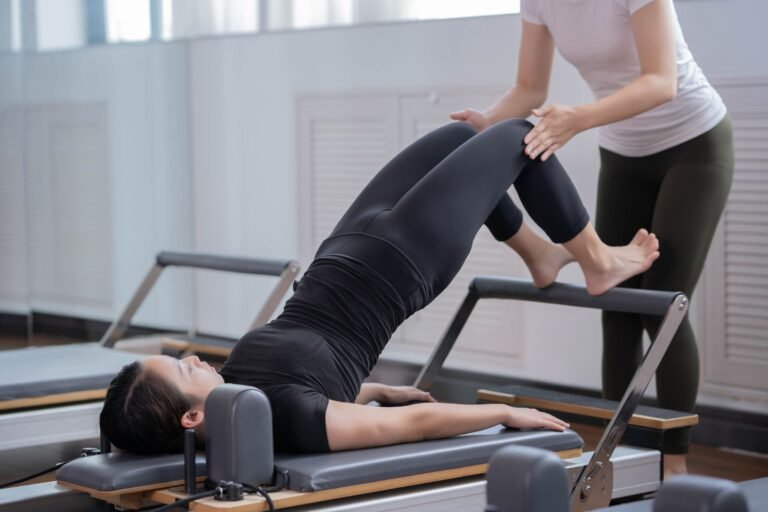
Consider familiar supine footwork, with the feet on the footbar. As the participant pushes the carriage away, the springs lengthen and oppose that movement. With the rest of the set-up unchanged, a heavier combination generally requires a stronger push. On the way back, the springs pull towards the starting position. The participant must manage that return rather than simply let the carriage accelerate into its stop.
This is a mechanical interpretation, not a claim that every muscle works harder throughout the repetition. The same change alters both the outward challenge and the inward pull. “The return is assisted” does not mean “the return requires no effort”.
Nor can the carriage path tell you exactly which muscles supplied that effort. Cantergi and colleagues (2015) found different hip and knee moment strategies during Reformer leg extensions, influenced by the direction of force applied at the footbar. An apparently similar movement can therefore involve different joint demands. Spring selection and movement observation belong together.
Our Mat–Reformer biomechanics comparison explains the broader apparatus differences. Here the focus is narrower: how to interpret a change in spring setting within a Reformer task.
Resistance and platform steadiness are different demands
Now consider an exercise in which the participant is trying to limit unwanted carriage movement. Reducing the spring resistance can make a small change in force more noticeable as carriage displacement. A setting that feels light to push may feel demanding to hold steady. That does not make instability an inherently better training stimulus.
Kim and colleagues (2024) tested hip roll, knee-off and elephant exercises in 18 healthy adult women. During hip roll, several measured muscles showed greater electrical activity with low spring resistance than with moderate resistance or a fixed platform. For knee-off and elephant, the reported significant comparisons involved low resistance versus the fixed platform. Those findings should not be rewritten as “lighter springs activate every core muscle more”.
A second study offers a useful counterpoint. Lee (2023) studied side splits in 28 healthy women. Heavier springs produced greater activity in the gluteus medius, internal oblique and multifidus, while lighter springs produced greater adductor longus activity. Movement characteristics also differed. The result was a redistribution of demand, not a single difficulty ranking.
These experiments help explain why two instructors can report different experiences without either observation being impossible. They may be discussing different movements, muscles or phases.
Three decisions that change the teaching
The following examples are EFWA’s educational interpretation of the mechanics and research. They are not a validated spring prescription or instructions for attempting unfamiliar exercises alone.
When the aim is leg effort
In established footwork, keep the footbar position, range and tempo consistent while assessing a spring change. Observe the outward press and the controlled return separately. Ask where the participant notices the effort. If a heavier setting shortens the chosen range or causes a rushed return, simply counting the added springs misses the change in the task.
One useful coaching record is: “Same range and pace; greater effort on the press; return remained controlled.” That describes the response more clearly than “advanced spring setting”. It also gives the next instructor something meaningful to compare.
When the aim is carriage control
For an already familiar supported exercise, decide how much carriage movement is intended before changing the spring. A lighter setting might expose difficulty keeping the carriage still. If the participant can no longer organise the movement, adding support or simplifying the task may serve the lesson better than insisting on the lighter setting.
The goal is not to manufacture shaking. Choose a challenge that lets the learner practise the intended skill. Standing or otherwise demanding balance tasks require suitable instruction and apparatus-specific procedures; the research examples above are not an invitation to experiment without supervision.
When a learner changes studio or machine
Treat the new apparatus as a fresh set-up. Spring colours are not a universal measurement system: Pilates Anytime’s equipment guide documents different conventions across brands (Pilates Anytime, 2026). A familiar colour or number of springs does not guarantee a familiar response.
Confirm the manufacturer’s instructions and the instructor’s intended setting before beginning. Record the apparatus and spring combination alongside the exercise, rather than describing a setting as “two springs” without context. Follow the manufacturer’s inspection and replacement guidance as well; choosing a training load does not replace checking the equipment.
A better progression note
Instead of recording only spring colour, write down the exercise, apparatus, set-up, intended range, pace and observed response. This makes it easier to tell whether a later session changed resistance, movement control or both. It also avoids presenting one participant’s preferred setting as a standard for the whole class.
For example, a learner might first practise a controlled return over a shorter chosen range, then maintain that control through the intended larger range. Another learner might keep range and pace consistent while changing resistance. These are different teaching decisions. The spring setting alone cannot explain either person’s progress.
EFWA’s educational position is to change a variable for a stated purpose, observe the result and keep the adjustment only if it serves that purpose. “Harder” is too vague to substitute for a goal such as producing more leg effort or controlling carriage travel.
What the evidence cannot settle
The spring studies discussed here are small, short-term experiments involving healthy women and selected exercises. Surface electromyography measures electrical activity; it does not directly establish future strength gains, exercise quality, injury prevention or suitability for a clinical condition. The studies do not provide a universally optimal spring combination, and their equipment-specific findings cannot be transferred unchanged to every Reformer.
This article offers general movement education, not individual rehabilitation advice. Instructors should work within their training, follow apparatus guidance and refer concerns outside their competence. A spring adjustment should not be used to diagnose or treat unexplained pain.
Explore related teaching topics in the Pilates Knowledge Hub. For structured study of resistance, alignment, controlled movement and teaching, see EFWA’s Level 3 Reformer Pilates Instructor Course.
References
Cantergi, D., Loss, J. F., Jinha, A., Brodt, G. A., & Herzog, W. (2015). Muscle strategies for leg extensions on a “Reformer” apparatus. Journal of Electromyography and Kinesiology, 25(2), 260–264. https://doi.org/10.1016/j.jelekin.2014.08.016
Kim, H.-J., Sung, J.-H., Ryu, J.-K., Jung, H.-C., & Wang, J. (2024). Effect of Reformer spring resistance modifications on core muscle activity during basic core muscle exercises. Healthcare, 12(23), Article 2447. https://doi.org/10.3390/healthcare12232447
Lee, K. (2023). Motion analysis of core stabilization exercise in women: Kinematics and electromyographic analysis. Sports, 11(3), Article 66. https://doi.org/10.3390/sports11030066
Pilates Anytime. (2026, February 6). What Pilates Reformer springs should I use? https://support.pilatesanytime.com/hc/en-us/articles/16005159457947-What-Pilates-Reformer-Springs-Should-I-Use
About the author: Dr Mert Eray Onen is EFWA’s Founder and Academic Director. His academic interests include applied anatomy, kinesiology and exercise physiology. Academic profile · ORCID.
Disclosure: EFWA provides instructor education, including the course linked above.