Online Pilates Training: Rewatch the Lesson, Understand the Movement

EFWA · PILATES EDUCATION · ONLINE LEARNING
You want to become a Pilates instructor, but you are unsure about studying online. Can you understand the movements properly through a screen? Who will answer your questions? Will you lose access to your lessons once the course ends? Where the training takes place matters, but so do the answers to these questions.
Dr Mert Eray Onen · European Fitness and Wellness Academy · 14-minute read
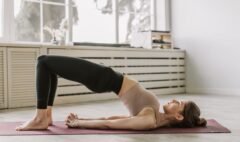
Imagine watching a Pilates exercise for the first time during face-to-face training. You are attending to the starting position, following the movement and trying to remember the breathing guidance. The tutor then explains the function of a muscle, and your attention shifts to that explanation. By the time your eyes return to the movement, that part of the demonstration has already passed.
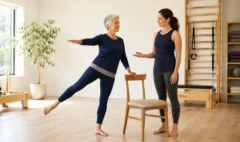
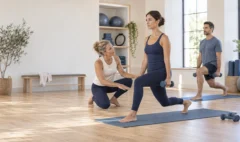
Now imagine that 10, 15 or even 20 other people are in the room. One learner is asking about foot placement, another is trying to understand the timing of the breath, and someone else needs a correction while practising. However experienced the tutor may be, the available lesson time and individual attention have to be shared across the class. Learners cannot be expected to notice every detail at the same moment or grasp every explanation at the same pace.
Missing a detail in that setting does not mean you cannot learn it; it means you need another opportunity to look. What matters is whether the training you choose gives you that opportunity. Being able to revisit the same explanation after the lesson allows learning to continue.
EFWA’s online Pilates packages give you unlimited opportunities to revisit every lesson, including after you have gained your certificate. Muscle images and names shown alongside the movement help you follow the applied anatomy, while access to tutors means you can ask questions when something remains unclear. When deciding whether online training is right for you, consider how directly these features answer your own learning needs.
You are not limited to hearing it once
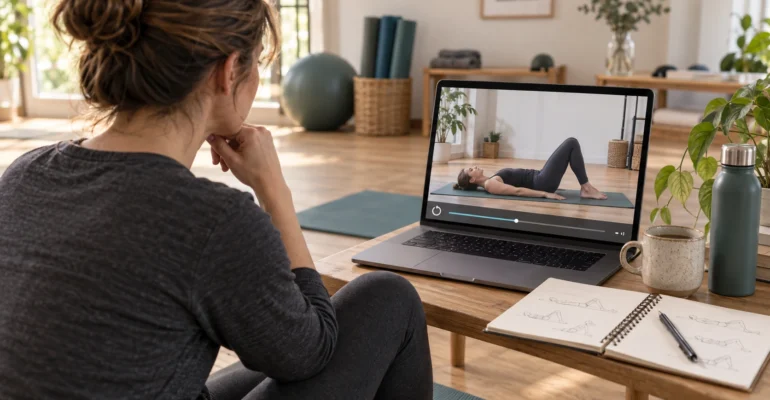
On a first viewing, simply understanding the sequence of a movement can be demanding. On the second, you might concentrate on the position of the spine and joints; on the third, you can focus on how breathing relates to the movement. Another replay may help you examine the tutor’s cues or the explanation of a common error. The pressure to absorb everything at once begins to ease.
For someone preparing to teach, in particular, a video becomes more than content to watch and complete. It becomes study material: something to consult before preparing your own demonstration, to check the purpose of an exercise and to help you formulate more precise questions. Learning is no longer confined to the first time you see the lesson.
With EFWA’s online Pilates training packages, you can return to every lesson as often as you need. Once a lesson has been completed, you can move backwards and forwards to revisit the relevant explanation and give a difficult point more time. Each learner can use the same lesson library according to their needs. If you need to hear a detail for the third time, the rest of a class does not have to wait and another lesson does not have to be arranged.
“Who can I ask if I do not understand?”
A natural concern for anyone considering online study is being left alone with unanswered questions. EFWA learners can submit questions to their tutors and receive a response. You can ask about a detail that remains unclear after replaying the lesson, a particular phase of the movement or an anatomical explanation. Access to recorded lessons is paired with a way to communicate with your tutor.
Replay access can also make your questions more useful. Instead of saying, “I do not understand this exercise”, you can identify the point at which you became unsure or the muscle function you would like clarified. Referring to the relevant lesson and section of the movement helps the tutor provide a more focused explanation.
For example, you may understand why the trunk is kept stable during a movement but remain unsure about how to apply that principle in your own practice. A question that identifies the relevant part of the lesson can take you beyond a general explanation. You can then return to the demonstration with the answer in mind. The recording, your question and the tutor’s explanation all contribute to the same learning process.
Understand the anatomy as you watch the movement
Anatomy in Pilates education should not be reduced to memorising a list of muscle names. What matters is understanding how an anatomical structure contributes to the movement being demonstrated. Which joint is moving? Which area remains stable? Which muscles help produce the movement, control it or maintain the position?
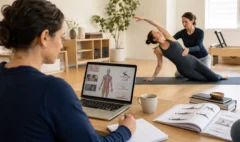
In EFWA’s anatomy-supported Pilates demonstrations, images and names of the relevant muscles appear on screen as the movement is performed. This allows you to connect the muscle name you hear with the body region and phase of movement you are watching. Rather than learning the movement and the anatomy separately and trying to connect them later, you can follow that relationship within the lesson itself.
Effective teaching does more than place a muscle name on the screen. It explains whether the muscle helps initiate the movement, control the return or stabilise a region. A muscle’s contribution may change across different phases, and many Pilates exercises require several muscle groups to work together.
As you watch a demonstration, ask yourself: “What is moving, what remains stable, and how does the tutor explain the muscles’ contribution?”
These visuals are teaching tools used to explain the relevant anatomical structures; they are not live measurements of muscle activity. A muscle highlighted in a demonstration should be considered alongside the other structures contributing to the exercise. This helps you move beyond copying the outward shape and examine why the exercise is performed in that way.
Why does showing information at the right moment matter?
When the relevant muscle name and explanatory visual appear at the appropriate point in a moving demonstration, they can direct the learner’s attention to the detail being discussed. Too many names, long paragraphs and competing visuals on screen, however, can make learning more difficult. The aim is not to display more information, but to present what is needed clearly.
Guidance on educational video design recommends dividing complex content into manageable sections, signalling important details and allowing spoken explanations and visuals to complement one another. Brief muscle labels appearing at the relevant point in an exercise, with teaching divided into sections that are easy to follow, show how these principles can be applied to Pilates education (Brame, 2015).
The practical test for a learner is straightforward. Can you follow the explanation while watching the demonstration? Can you see where the relevant muscle is and understand which phase of the exercise the explanation refers to? Can you return to that section and examine the connection again when necessary?
Face-to-face or online? Look beyond the end of the lesson
Face-to-face training allows a tutor to observe a learner directly and provide an immediate correction when appropriate. Practising and asking questions in the same physical space are important advantages. The amount of individual feedback available, however, depends on class size, lesson length and how the training is organised.
If no recording is provided, you may not be able to hear the entire lesson delivered in the same way for a second time after leaving the room. You can ask a tutor to demonstrate a movement again, but the time available still depends on the flow of the lesson and the tutor’s availability. Being able to revisit the whole lesson independently, whenever you need it, offers a different kind of learning opportunity.
| Learning need | Face-to-face training without recordings | Structured online training with replay access |
|---|---|---|
| Hear the same explanation again | Depends on the tutor’s availability or another lesson. | The recorded lesson can be revisited independently. |
| Examine a detail you missed | You ask for another explanation within the available class time. | You can return to the relevant section and study it with a specific focus. |
| Connect anatomy with movement | Depends on the tutor’s explanation and the materials used. | Synchronised visuals can present muscle names alongside the relevant phase of movement. |
| Receive individual feedback | Can occur while the tutor observes you; the class format determines what is possible. | A defined process is needed for questions, review of practice and assessment. |
| Refresh your knowledge after certification | Future access depends on the materials and support supplied by the course. | EFWA packages retain unlimited replay access to the lessons after certification. |
Some programmes provide recordings alongside face-to-face teaching or combine both formats. The deciding factor is what the programme you are considering actually offers. If you learn by hearing explanations more than once, find it difficult to keep pace with a group or want to consult lessons after completing your training, EFWA’s online structure responds directly to those needs.
Gain your certificate and keep your lessons within reach
The need to learn does not end when your training is complete. While preparing a class of your own, you may notice a new question about a movement that once seemed straightforward. You may want to check how to phrase a cue, the purpose of a transition or the detail behind an anatomical explanation.
Unlimited lesson replay continues after you gain your certificate with EFWA’s online Pilates packages. This turns the course materials from a resource used only while preparing for assessment into a lesson library you can consult during your professional development.
As your practical experience develops, you may notice details that escaped you when you first learnt a topic. The ability to use the same recording to answer different questions at different stages is a tangible benefit of continued access. Months later, for example, you may be preparing a class and want to check the breathing cue for a particular exercise or revisit a correction you previously learnt. You do not need to purchase the same training again; you return to the lessons you already have.
Training may be easier to fit around your life
Online training can make it easier to create study time around work and family responsibilities. You can follow recorded lessons when it suits you and divide a difficult section into shorter study sessions. Instead of having to keep pace with a single day, you can establish a routine that you are able to sustain.
You do not need to travel to a training centre or arrange accommodation to access recorded online lessons. If you live in another city or country, that can make a meaningful difference to both time and budget. The hours you would have spent travelling can be used to study, organise your notes and practise. You still need to make room for regular study, but you can decide when that time fits your circumstances.
One evening, for example, you might concentrate only on the movement demonstration. On another day, you can return to the anatomical explanation and send your tutor a question that arose during practice. Training then becomes a study process that fits into everyday life, rather than a one-off event set apart from it.
Turn replay into purposeful study
Unlimited access is valuable, but it becomes more useful when you decide what you want to learn from each viewing. Rather than replaying an entire video without a specific focus, consider which question you would like to be able to answer by the end of your next study session.
- Watch the whole movement first. Identify the starting position, sequence and main purpose of the lesson.
- Return to one detail. Focus on breathing, alignment, the function of a muscle or the explanation of a correction.
- Explain it in your own words. Close the recording, describe the purpose of the movement and its key cues, then compare your account with your notes.
- Practise and seek feedback. Use the practical process within the course to test your demonstration and explanation; ask your tutor about anything that remains unclear.
- Return on another day. Check what you remember and revisit the sections you have not yet mastered.
A substantial research synthesis on learning verbal information found that spacing study sessions over time affects later retention. This provides a rationale for revisiting anatomy and lesson content across different days (Cepeda et al., 2006). A lesson library that remains available makes this kind of study routine easier to follow.
Aim to learn the movement and teach it
Clear movement demonstrations, accurate applied anatomy, understandable explanations and replay access are reasonable foundations to expect. They should be accompanied by a way to have questions answered and clear information about how practical competence is assessed. Learners should understand what they are expected to know and do in order to complete the course.
A well-structured programme connects theory, movement demonstrations, knowledge checks and practical assessment. It helps the learner progress from recognising an exercise to explaining its purpose and teaching it appropriately. The number of videos alone is not a measure of quality; what matters is how the lessons function within a learning process.
At EFWA, lesson knowledge checks, theoretical learning and practical competence form parts of the training. You can use video replays to prepare for this work, returning to the lessons to explain an exercise’s purpose, identify important details in the demonstration and develop your own cues. The value of access grows with the way you use it.
When evaluating an online programme, therefore, it is not enough to count its videos. Look for training that allows you to test what you have learnt, receive answers to your questions and return to the lesson you need. That structure gives you a practical basis for both initial learning and preparation to teach.
Frequently asked questions
Can I still watch the lessons after gaining my certificate?
Yes. With EFWA’s online Pilates packages, you can return to every lesson as often as you need, including after you have gained your certificate.
Why is it useful to see muscle names during a movement?
Presenting the names alongside appropriate anatomical visuals can make it easier to connect the structure being explained with the movement being demonstrated. The tutor’s explanation of the muscle’s contribution at that stage makes the connection more meaningful.
Can I ask a tutor questions during online training?
Yes. EFWA learners can submit questions to their tutors and receive a response. Identifying the relevant lesson section and the point that is unclear helps the tutor address the question more precisely.
Does watching every video mean I am ready to teach?
Completing the lessons is one part of the training. Teaching also requires practical competence, clear communication, appropriate cueing and assessment of your work. Replay access is a resource that supports this development.
Choose Pilates training that suits the way you learn
If you are unsure about online study, consider the conditions in which you learn most effectively. If hearing explanations again, revisiting details within a movement, following the anatomy during the demonstration and putting questions to your tutor matter to you, EFWA’s online Pilates training may be a particularly good fit.
These benefits are not temporary conveniences that disappear when you complete the training. You can continue to revisit every lesson without a viewing limit after gaining your certificate, using what you have learnt while planning classes and developing your practice. When making your choice, consider not only the days on which you train but also the learning resource that remains available afterwards.
Explore the programme content and choose the training that fits your goal.
References and scope of the evidence
The sources below concern educational video design and the retention of information. They are not direct comparisons between EFWA courses and face-to-face Pilates courses. Developing the ability to teach Pilates requires physical practice, feedback and assessment of competence alongside the revisiting of knowledge.
Brame, C. J. (2015). Effective educational videos. Vanderbilt University Center for Teaching. Teaching guide shared by the author.
Cepeda, N. J., Pashler, H., Vul, E., Wixted, J. T., & Rohrer, D. (2006). Distributed practice in verbal recall tasks: A review and quantitative synthesis. Psychological Bulletin, 132(3), 354–380. Research article.