Weighted-Vest Walking: Useful Progression or Overhyped Shortcut?

Weighted-Vest Walking: Useful Progression or Overhyped Shortcut?
Fitness & Training Science
Weighted-Vest Walking: Useful Progression or Overhyped Shortcut?
Weighted vests can make walking more demanding, but the current evidence does not justify treating them as a shortcut to stronger bones, major fat loss or complete strength training.
Estimated reading time: 6 minutes
Does walking with a weighted vest work?
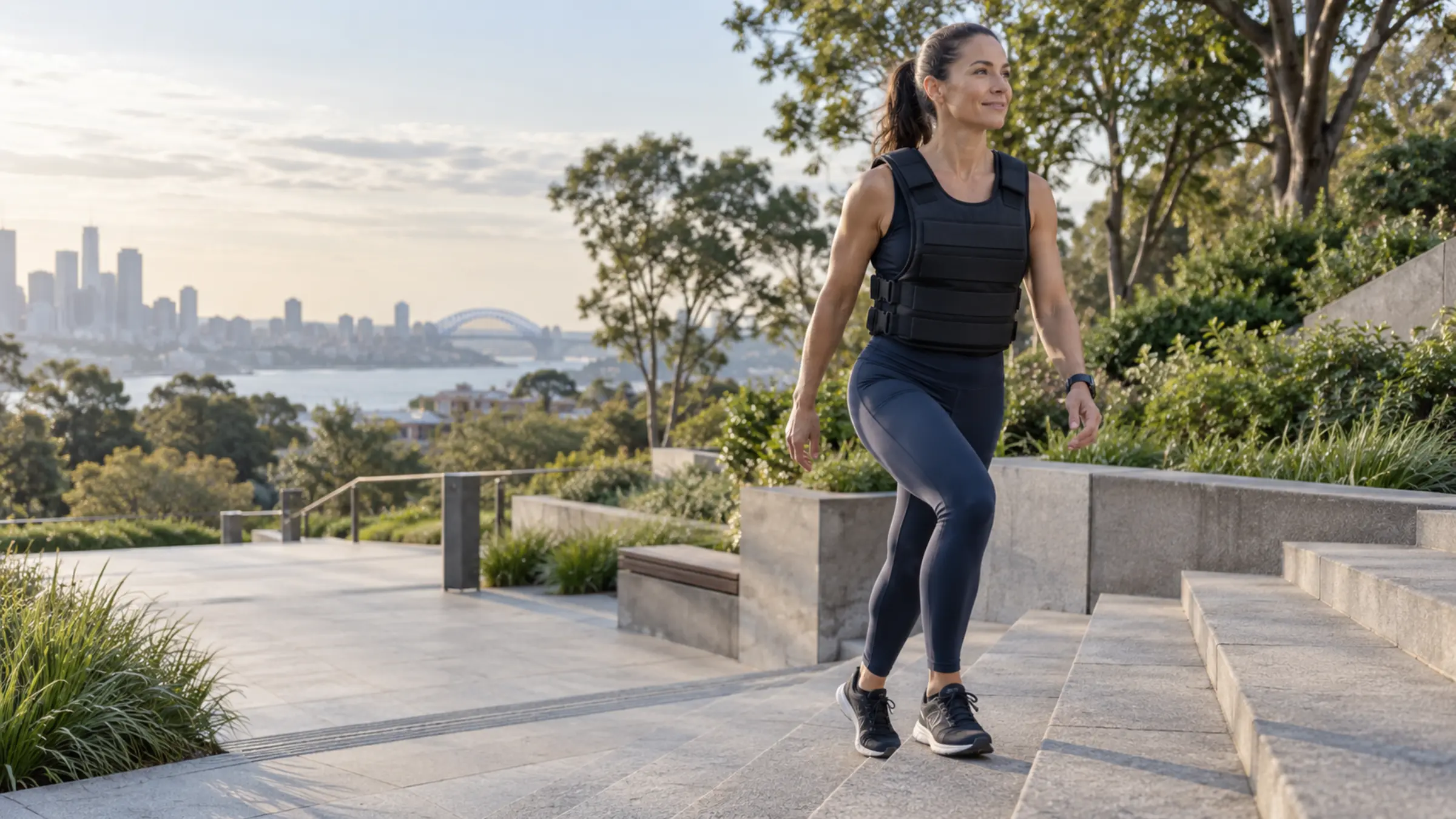
Yes, if “work” means making the same walk mechanically and physiologically harder. Carrying additional mass increases the force that must be supported and moved. On hills, stairs or at a brisk pace, that can raise perceived effort and provide a useful progression when simply walking faster is impractical.
That modest conclusion is better supported than many of the promises surrounding the trend. A vest does not automatically build substantial muscle, correct posture, prevent osteoporosis or produce meaningful weight loss. Those outcomes depend on the size and progression of the training stimulus, the person using it, the activity performed and the rest of the programme.
Why has weighted-vest walking become so popular?
The appeal is easy to understand. The vest leaves the hands free, fits into an existing walk and provides an obvious sense of “doing more”. It also sits close to the body compared with carrying dumbbells at the sides. Recent media interest has connected weighted vests with walking, healthy ageing, bone health and exercise during weight loss.
Popularity, however, is not the same as proof. The research uses very different protocols: some studies combine vests with jumping or structured strength exercises; others ask older adults to wear a vest for hours during daily activity. Those findings cannot be transferred directly to a twenty-minute neighbourhood walk.
What does the evidence actually show?
Established: external load changes the task
Adding mass means more work is required to move the body through each step. The size of the effect will vary with vest load, walking speed, gradient, duration, fitness and body size. For an already active person, a very light vest on a slow, flat walk may create only a small additional stimulus. The same vest on stairs may feel very different.
Promising but specific: strength and balance
Older trials reported improvements in selected measures when weighted vests were part of progressive, supervised exercise. Shaw and Snow (1998), for example, studied 44 postmenopausal women and found improvements in balance-related measures, lower-body strength and power after a nine-month programme. Importantly, the intervention was not “wear a vest and carry on as normal”; it was structured lower-body exercise performed three times a week with individually progressed resistance.
A later small trial combined vest loading with multimodal exercise in postmenopausal women and found changes in ankle strength and markers of bone turnover (Klentrou et al., 2007). These studies suggest that a vest can be a practical way to load exercise. They do not show that vest walking is superior to well-designed resistance training.
Uncertain: bone protection
Bone claims require particular care. In a 2025 randomised clinical trial, 150 older adults living with obesity completed a year-long weight-loss intervention. Adding prolonged daily weighted-vest use or supervised resistance exercise did not meet the trial’s primary aim of better preserving hip or trabecular bone density compared with weight loss alone (Beavers et al., 2025). The vest was worn for up to eight hours a day and was progressively loaded to replace lost body weight, so this was also very different from recreational walking.
The reasonable conclusion is not that loading is irrelevant to bone. Rather, a weighted vest is only one possible source of mechanical loading, and its effect depends on how that load is delivered. Resistance training, impact exercise where appropriate, adequate nutrition and clinical management may all matter. A fitness professional should not present a vest as treatment for osteopenia or osteoporosis.
Not established: a weight-loss shortcut
A loaded walk may expend somewhat more energy than the same walk without the vest. That does not mean the difference will be large, nor that it guarantees fat loss. Long-term weight change is influenced by total energy intake, activity, adherence, sleep, medication and health context. A vest can increase exercise demand; it does not override those factors.
The EFWA LOAD check for weighted-vest walking
Before adding a vest, use LOAD to decide whether it solves a genuine programming problem.
LOAD is an EFWA educational framework, not a medical screening instrument.
- L — Learner readiness. Can the person already walk with stable, comfortable mechanics at the intended pace and terrain? New or unexplained pain, dizziness, unusual breathlessness, balance concerns or recent injury require assessment rather than more load.
- O — Objective. Decide what the vest is meant to change: perceived effort, hill-walking preparation, hands-free loading or progression of selected bodyweight movements. If the objective is maximal strength, a conventional resistance programme is likely to offer more precise progression.
- A — Added demand. Change one variable at a time. A vest, steeper route, faster pace and longer duration added together make it difficult to identify what the person tolerates. The first exposure should feel deliberately conservative.
- D — Data from the session. Monitor technique, talk test, effort, comfort during the walk and recovery afterwards. Progress only when the added demand is useful and repeatable, not merely uncomfortable.
Worked example: progress the walk, not the hype
A client already completes two brisk 35-minute walks each week and wants preparation for a hilly holiday. Their current walks feel comfortable, and they have no relevant symptoms or movement concerns. The trainer first introduces a route with short hills while duration remains unchanged. If walking quality and next-day recovery remain satisfactory, a light, evenly fitted vest can later provide another progression.
The trainer does not promise stronger bones or faster fat loss. The programme records the route, duration, perceived effort and vest load so that progression is observable. Strength sessions remain in the week because vest walking is being used to complement, not replace, resistance training.
Who should be more cautious?
A vest changes loading, balance and heat retention. Stop the session if it causes pain, altered gait, loss of balance, chest discomfort, dizziness or unusual breathlessness. People with known cardiovascular, respiratory, neurological, bone or joint conditions; a history of falls; pregnancy; recent surgery or injury; or concerns about medication and exercise should seek individual advice from an appropriate clinician before using added load.
Fitness professionals should work within their qualifications, check that the vest fits securely and distribute weight evenly, and avoid treating a social-media percentage as a universal starting rule. The appropriate load is the smallest one that creates the intended training effect without degrading movement or recovery.
Evidence limitations
Weighted-vest research is small and heterogeneous. Participants, activities, vest loads and outcomes differ, and several often-cited studies are decades old. Findings from supervised exercise in postmenopausal women or prolonged vest use during dietary weight loss do not establish what happens during ordinary recreational walking. There is also insufficient evidence to declare a universal load, frequency or progression rate.
The bottom line
A weighted vest can be a useful incremental stressor, but it is not a fitness shortcut. Use it when it clearly serves the programme, progress it conservatively and judge it by movement quality and recovery. Keep expectations measured: the vest may make walking harder, while claims about bone density, posture, muscle growth and weight loss remain much more context-dependent.
Explore more evidence-informed resources in the EFWA Knowledge Hub, meet the Academic Team, review progressive overload in resistance training, or explore EFWA’s Personal Trainer Courses.
References
- Beavers, K. M., Lynch, S. D., Fanning, J., Howard, M., Lawrence, E., Lenchik, L., Shapses, S. A., Weaver, A. A., Wherry, S. J., Zamora, Z., Nicklas, B. J., & Beavers, D. P. (2025). Weighted vest use or resistance exercise to offset weight loss-associated bone loss in older adults: A randomized clinical trial. JAMA Network Open, 8(6), e2516772. https://doi.org/10.1001/jamanetworkopen.2025.16772
- Klentrou, P., Slack, J., Roy, B., & Ladouceur, M. (2007). Effects of exercise training with weighted vests on bone turnover and isokinetic strength in postmenopausal women. Journal of Aging and Physical Activity, 15(3), 287–299. https://doi.org/10.1123/japa.15.3.287
- Shaw, J. M., & Snow, C. M. (1998). Weighted vest exercise improves indices of fall risk in older women. The Journals of Gerontology: Series A, 53A(1), M53–M58. https://doi.org/10.1093/gerona/53a.1.m53
- UK Chief Medical Officers. (2019). UK Chief Medical Officers’ physical activity guidelines. Department of Health and Social Care. https://www.gov.uk/government/publications/physical-activity-guidelines-uk-chief-medical-officers-report