Pregnancy Pilates Instructor Course
About This Course
Pregnancy Pilates Instructor Course | Online Certification, EFWA
How this programme is delivered
This programme is delivered entirely online. Lectures and assessments are completed remotely at your own pace, with tutor support through the course Q&A. There is no in-person practical observation.
About this course
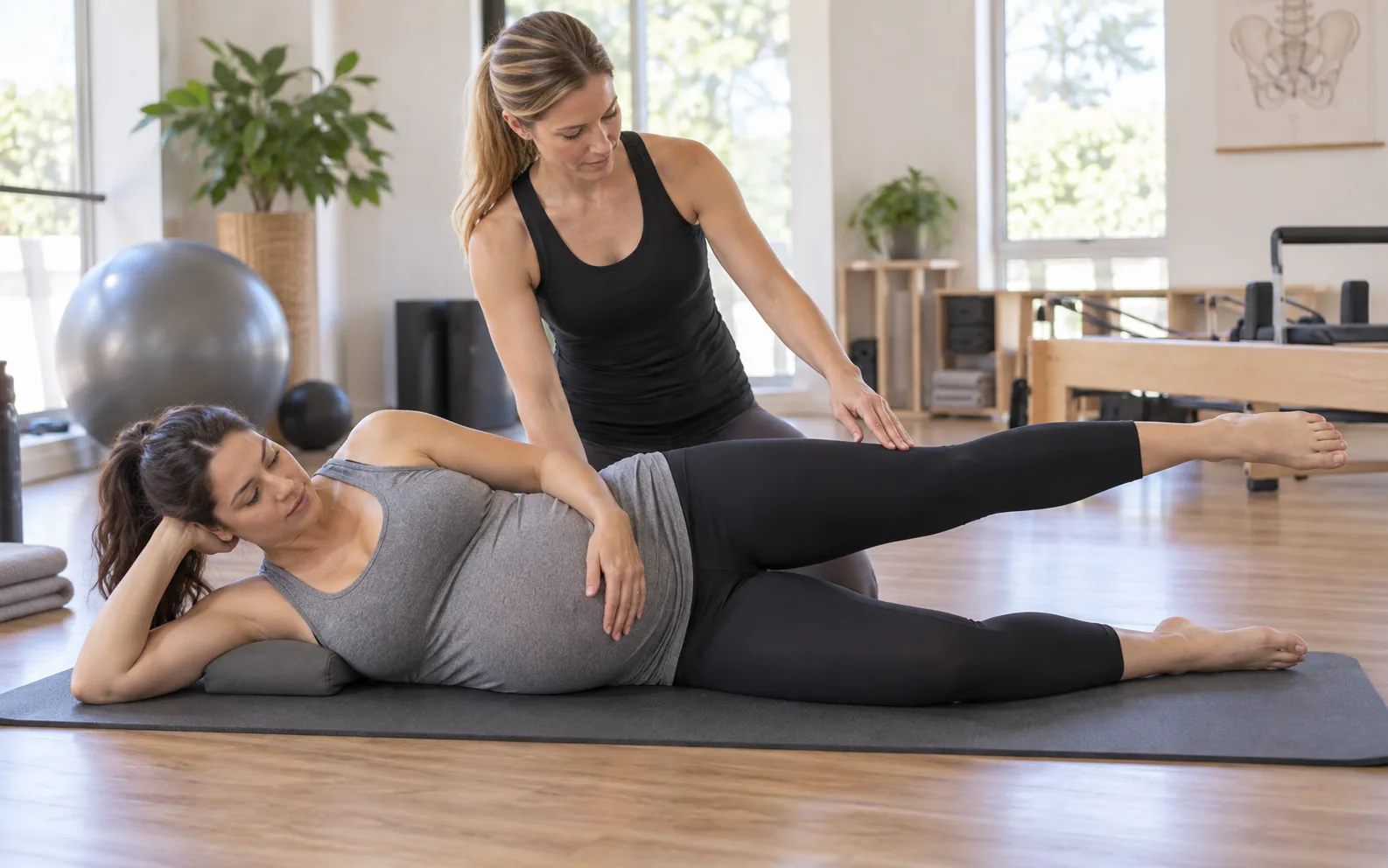
Pregnancy changes how the body produces and controls movement. Posture shifts, the centre of gravity moves, ligaments become more lax, and the demands on the pelvic floor and abdominal wall change from trimester to trimester.
This course covers what those changes mean for programming: which exercises to modify, which to set aside, and how to adapt a session for the person in front of you. It is built for instructors who already teach, or who are preparing to teach, and who want to work confidently with pregnant and postnatal clients.
The academic foundation
Every EFWA Pilates programme is built on the same theoretical core, included here in full:
Foundation 1 — Locomotor System Anatomy: the skeletal and muscular systems, with a knowledge assessment.
Foundation 2 — Exercise Physiology: energy systems and the mechanisms of muscle contraction and movement production.
Foundation 3 — Systems Anatomy and Physiology: respiratory and cardiovascular function, with a knowledge assessment.
The pregnancy-specific module builds on that foundation rather than replacing it. This is why the guided learning time is considerably longer than the demonstration videos alone.
Essential details
Certificate awarded: EFWA Certificate in Pregnancy Pilates Instruction
Format: 100% online, self-paced
Endorsement: International Pilates Federation (IPF)
Support: Tutor support through course Q&A, unlimited access
Guided learning time: Approximately 10 hours
The EFWA Anatomical Overlay
Every practical demonstration runs alongside an anatomical panel prepared by Dr Mert Eray Onen, author of Anatomy of the Locomotor System. For each exercise the panel identifies the joints involved, the movement occurring at each, the muscles producing that movement, the muscles stabilising isometrically, and the muscles being lengthened.
In a prenatal context this matters more than usual: knowing precisely which structures are loaded by a given position is what allows you to judge whether a modification is genuinely necessary.
Who teaches what. Theoretical modules — anatomy, kinesiology and exercise physiology — are delivered by Dr Mert Eray Onen, who has taught these subjects at university level since 2004. Practical demonstrations are delivered by Melisa Arslan, with the anatomical analysis for each exercise prepared by Dr Onen.
What you will learn
Anatomical and physiological change across the trimesters. How the skeleton, musculature and connective tissue adapt during pregnancy — posture, centre of gravity, ligament laxity — and what each change means for exercise selection.
Programming and modification. Which movements to adapt, which to avoid, and how to work with common presentations including pelvic girdle pain, diastasis recti and round ligament discomfort.
Breathing and pelvic floor coordination. Diaphragmatic breathing, pelvic floor function, and relaxation techniques.
Postnatal return to exercise. How to screen, how to rebuild core and pelvic floor function progressively, and how to set expectations that respect individual recovery.
Communication. Cueing language, client screening, session structure, and building confidence with clients who may be anxious.
Working within your scope
Pregnancy is a period in which exercise decisions can carry clinical significance. This course prepares you to teach movement — it does not qualify you to provide clinical care, to assess or treat pregnancy complications, or to accept referrals from healthcare professionals.
The NHS advises that pregnant women should tell their instructor that they are pregnant and how many weeks along they are. Screening, appropriate referral to a midwife or GP where indicated, and knowing when not to proceed are part of teaching responsibly.
Preparing to teach: from watching to practising
Preparing to teach Pilates involves more than watching the lesson videos once. Understanding the theory and learning to perform and teach movements clearly takes time, note-taking and regular repetition. The running time of the videos is therefore not your total learning and practice time.
Start by watching the lessons carefully, taking notes and revisiting anything you do not understand. Then practise each movement yourself, pausing and replaying the video as needed. Consider the starting position, breathing, movement control and the accompanying anatomical explanations together. The aim is not simply to remember a movement, but to understand how and why it is performed.
As your own practice develops, you can practise explaining suitable, safe movements to a willing adult friend or family member. This does not replace professional teaching; it helps you develop clear instructions and movement observation skills. Do not continue movements that cause pain, and avoid exercises that are unsuitable for the person’s health or outside your competence. Specialist work with children, pregnant or postnatal participants must also follow the course’s relevant safety, screening and safeguarding guidance.
Self-paced distance learning involves a cycle of watching, practising, reviewing and repeating. Return to the lessons whenever you need to, and share your questions in the course Q&A area. Completing a video or passing an assessment does not, on its own, mean you are ready to teach. The goal is to develop the ability to apply and communicate what you have learnt safely, with control and clarity.
Who this course is for
Practising Pilates instructors who want to extend their teaching to pregnant and postnatal clients.
Fitness and movement professionals — personal trainers, coaches, therapists — working with women through pregnancy and recovery.
Those preparing to teach, studying this alongside foundation Pilates training.
Frequently asked questions
Do I need existing Pilates training?
This course assumes familiarity with the mat repertoire. If you are new to Pilates, we would suggest studying the Mat Pilates course first, or taking the Master Pilates Programme, which includes both.
Join learners in more than 60 countries studying Pilates with EFWA.
Enrol Now: Start Your Pregnancy Pilates Instructor Course Today.
Learning Objectives
Material Includes
- Video lectures with anatomical overlay panels · Knowledge assessments · Tutor Q&A access · Unlimited access to course materials · EFWA certificate on completion
Target Audience
- Practising Pilates instructors extending their teaching to pregnant and postnatal clients.
- Personal trainers, fitness coaches and therapists working with women through pregnancy and recovery.
- Those preparing to teach, studying alongside foundation Pilates training.
Curriculum
Locomotor System Anatomy
Skeletal System38:03
Muscular System00:35:53
Locomotor System Anatomy Quiz
Exercise Physiology
Anatomy and Physiology
Pregnancy Pilates Course
Your Instructors


Dr. Mert Eray Onen
PhD · Founder & Academic Director, EFWA
Dr Mert Eray Onen is the founder of the European Fitness and Wellness Academy and the author of Anatomy of the Locomotor System, 2022.
He has taught human anatomy and kinesiology at university level since 2004, delivering these subjects across all departments of the Faculty of Sport Sciences at Kocaeli University, where he remains a member of the teaching staff. He holds a PhD in Sport Health Sciences from Marmara University and an MSc in Coaching Education from Celal Bayar University, where he graduated first in his cohort.
Published work
Alongside Anatomy of the Locomotor System, his books include Doping in Sport, second edition 2014. He is editor and contributing author of Training Physiology, 2026, for which he wrote the chapters on muscle physiology, neuromuscular control, and the peripheral and central mechanisms of exercise-induced fatigue. He has contributed chapters on muscle physiology and fatigue mechanisms to Exercise and Sport Physiology. His research has appeared in peer-reviewed journals including the Journal of Bodywork and Movement Therapies, most recently on the effects of massage practice on low back pain and physical fitness.
Teaching in Pilates and movement
In 2011–2012 he delivered the anatomy, kinesiology and exercise physiology curriculum across all International Pilates Federation instructor programmes — Matwork I–II and Reformer I–II — and served as the Federation’s Vice President for Education and Chair of its Education and Science Board. He has taught sports anatomy on Turkish Gymnastics Federation Pilates instructor courses in 2010, 2011, 2015 and 2016.
Beyond Pilates, he has delivered anatomy, physiology and nutrition modules on national coaching certification courses across more than fifteen sports, including swimming, athletics, tennis, judo, boxing, handball and bodybuilding. Since 2004 he has been programme coordinator and anatomy lecturer on the massage therapist training courses run jointly by the Turkish Society of Physical Medicine and Rehabilitation and the Ministry of National Education.
In 2025 he received the Best Educator award at the 9th International Achievement and Career Award.
At EFWA
Dr Onen writes and delivers the theoretical modules of EFWA’s programmes, and prepares the anatomical analysis that accompanies every practical demonstration: the joints involved, the movement occurring at each, the muscles producing it, the muscles stabilising isometrically, and the muscles being lengthened.
£149.00
Material Includes
- Video lectures with anatomical overlay panels · Knowledge assessments · Tutor Q&A access · Unlimited access to course materials · EFWA certificate on completion