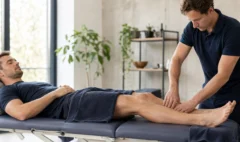
Massage Guns Before or After Exercise? What the Evidence Supports

EFWA KNOWLEDGE HUB · MASSAGE & THERAPY
By Dr Mert Eray Onen, Founder & Academic Director, EFWA · ORCID 0000-0001-8510-7293
Estimated reading time: 6 minutes
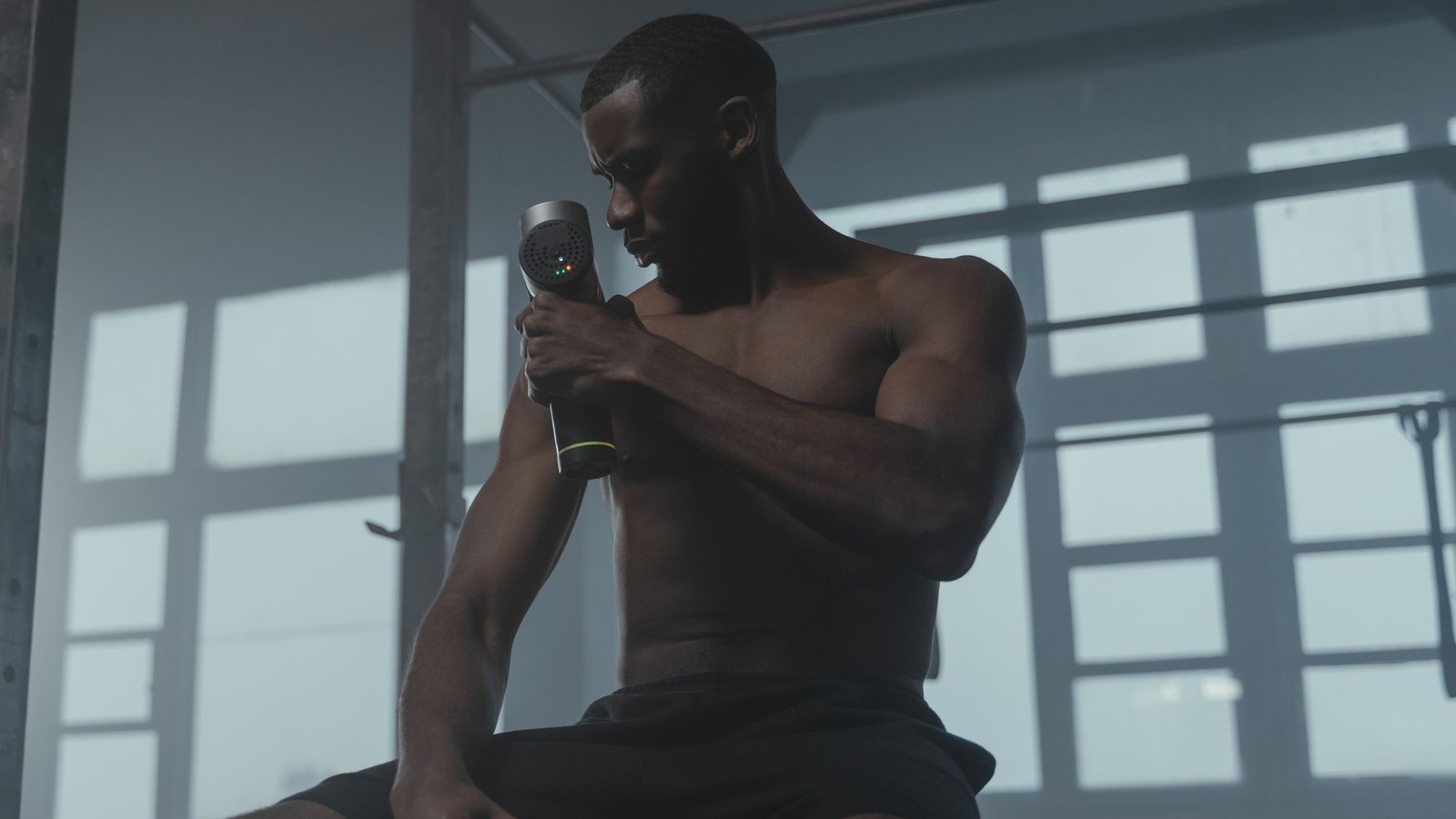
Direct answer: a massage gun can produce short-term changes in range of motion or perceived readiness, but it is not a superior warm-up and does not reliably improve strength, sprinting or explosive performance. After exercise, emerging evidence suggests possible benefits for recovery of some performance measures, while effects on soreness and maximal strength remain uncertain.
The useful question is therefore not simply “before or after?” It is “what outcome are you trying to change, and does the device improve that outcome without compromising the next task?” A handheld percussion device is one optional tool. It is not a substitute for progressive loading, sleep, nutrition, appropriate recovery time or assessment of an injury.
What does a massage gun actually do?
Massage guns deliver repeated mechanical pulses through a small contact head. Research usually calls this percussive therapy or percussive massage. It should not be assumed to reproduce a practitioner-delivered sports massage: the contact, decision-making, pressure control and context are different.
A 2023 systematic review included only 11 studies, most with moderate risk of bias. It found reasonably consistent short-term improvements in flexibility or range of motion, but no dependable improvement in strength, balance, acceleration, agility or explosive performance. That pattern matters. Feeling looser is not the same as being better prepared for every physical task.
Before exercise: readiness is not the same as performance
Using a massage gun before training may make a body area feel less stiff. That may be useful when the immediate goal is comfort or access to a movement range. It does not follow that the device will make a person faster, stronger or more powerful.
In a 2025 randomised crossover study of 16 trained athletes, adding massage-gun work to a dynamic warm-up reduced some jump measures and slowed sprint performance compared with the dynamic warm-up alone. The sample was small, so this is not a universal verdict, but it challenges the assumption that an extra recovery tool automatically improves preparation.
A larger 2026 study reached a similar practical conclusion. Fifty-nine recreational athletes completed a standardised dynamic warm-up. Those who then received 12 minutes of percussive massage reported greater readiness, yet several countermovement-jump variables worsened and mobility and sprinting did not improve. Perception changed more favourably than performance.
For a session involving sprinting, jumping or heavy lifting, dynamic activity and task-specific rehearsal should remain the centre of the warm-up. A massage gun, if used at all, should not displace those elements or be judged only by sensation.
After exercise: promising signals, not a recovery guarantee
The newest pooled evidence is more encouraging but still limited. A 2026 systematic review and meta-analysis of 12 randomised trials found that percussive therapy improved recovery of countermovement-jump performance and reduced creatine kinase compared with control conditions. Certainty was low for the jump result and very low for the biochemical result.
The same analysis found no clear benefit for recovery of maximum voluntary contraction or delayed-onset muscle soreness. Exploratory dose findings were inconsistent and were not suitable as prescriptive thresholds. In other words, the evidence does not justify promising that a particular speed or number of minutes will remove soreness or restore every form of performance.
Creatine kinase is also an indirect marker that varies substantially between people. A change in one blood marker should not be presented as proof that the muscle has “recovered” in every meaningful sense. The practical outcomes—movement, force, fatigue, soreness and readiness for the next session—still need to be considered separately.
The EFWA TOOL check
EFWA educational position: TOOL is a decision aid for instructors and practitioners. It is not a treatment protocol.
T — Task first
Name the next demand. Mobility work before an easy technical session is different from preparation for maximal sprinting or jumping.
O — Outcome, not marketing
Choose one observable outcome: comfortable range, perceived stiffness or performance in a specific warm-up movement. Avoid vague claims such as “flushes toxins” or “accelerates healing”.
O — Order matters
If the device is used before exercise, follow it with active movement and task rehearsal. Do not let passive preparation become the whole warm-up.
L — Limits and response
Use the product according to its instructions and within professional scope. Stop if it causes pain, numbness, unusual symptoms or a worse movement response. A device should not be used to mask a suspected injury or to justify continuing a session that needs assessment.
A practical example: preparing for a lower-body power session
An athlete reports that the calves feel stiff before a jumping session. The coach first observes a comfortable ankle movement and a low-intensity jump. A short, conservative bout of percussive massage may be tried if the athlete already uses the device safely. The athlete then repeats the movement and completes the planned dynamic warm-up.
If ankle movement feels easier but jump quality falls, the device has not improved preparation for the actual task. If neither measure changes, it is optional rather than necessary. If pain or altered sensation is present, the priority is not a harder device setting; it is stopping the experiment and following an appropriate assessment or referral pathway.
What is established, emerging and interpretive?
- Established evidence: massage guns can produce short-term changes in flexibility or range of motion, but pre-exercise performance benefits are not reliable.
- Emerging evidence: post-exercise percussive therapy may help recovery of selected explosive-performance measures, although certainty and dosing evidence remain limited.
- EFWA educational position: judge the device by the next relevant movement or performance task, not by how intense or “released” the area feels.
Evidence limitations and professional scope
Trials use different devices, frequencies, amplitudes, contact times, muscle groups and comparison conditions. Samples are often small and dominated by healthy, active young adults. Blinding is difficult, and expectations may influence self-reported readiness or soreness. Findings cannot be transferred automatically to people with pain, injury, neurological symptoms, circulatory concerns or recent surgery.
Fitness instructors and massage practitioners should not diagnose an injury, prescribe medical treatment or promise accelerated healing. Work within training, education and massage scope; follow current product guidance, screening procedures, insurer conditions and referral pathways.
The practical takeaway
A massage gun may be useful for a short-term mobility or comfort goal, but it is not an automatic upgrade to a warm-up. Before exercise, protect dynamic and task-specific preparation. After exercise, describe possible recovery effects modestly. In both cases, define the outcome, re-test it and keep the device optional.
Read EFWA’s guide to sports massage and exercise recovery, review how to design a warm-up without creating fatigue, explore Massage & Therapy Courses, or visit the EFWA Knowledge Hub.
References
- Driller, M., Holt, A., Carmichael, M., Payne, L., & Stutter, L. (2026). Perceptual gains, performance pains? Massage gun use during warm-up enhances perceived readiness without performance benefits. International Journal of Sports Science & Coaching. Advance online publication. https://doi.org/10.1177/17479541251408295
- Ferreira, R. M., Silva, R., Vigário, P., Martins, P. N., Casanova, F., Fernandes, R. J., & Sampaio, A. R. (2023). The effects of massage guns on performance and recovery: A systematic review. Journal of Functional Morphology and Kinesiology, 8(3), 138. https://doi.org/10.3390/jfmk8030138
- Ormeno, L., & Driller, M. (2025). Does massage gun or foam roller use during a warm-up improve performance in trained athletes? Sports, 13(9), 282. https://doi.org/10.3390/sports13090282
- Zhu, Y., Yang, L., Liu, T., Yao, F., Wang, Q., & Yi, Z. (2026). Effects of percussive therapy dosages on recovery from acute exercise-induced muscle damage: A systematic review and meta-analysis. Chiropractic & Manual Therapies, 34, 34. https://doi.org/10.1186/s12998-026-00657-9
This article provides general professional education and is not medical advice or an individual treatment plan.
Author disclosure: Dr Onen is EFWA’s Founder and Academic Director. EFWA provides professional education in this subject area. No product or manufacturer is endorsed.