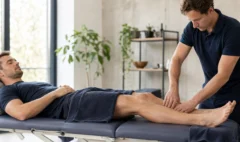
What Should a Massage Therapist Record in Client Notes?


EFWA KNOWLEDGE HUB · MASSAGE & PROFESSIONAL PRACTICE
By Dr Mert Eray Onen, Founder & Academic Director, EFWA · ORCID 0000-0001-8510-7293
Estimated reading time: 6 minutes

A useful massage note records what mattered to the decision: the date, the client’s reason for attending, relevant changes, consent and preferences, what was done, how the client responded, any advice or referral, and the agreed next step. It should be factual, legible, proportionate and written soon after the session—not a transcript and not a collection of unsupported diagnoses.
Good notes are sometimes treated as an administrative burden. In practice, they support continuity, professional accountability and safer decision-making. They help the therapist remember why a technique was chosen, what the client declined, whether an unexpected response occurred and what should be reviewed next time.
More detail is not automatically better. A record that contains irrelevant personal information can be harder to use and creates an unnecessary privacy burden. The goal is a concise account that another appropriately authorised professional—or the therapist six months later—could understand.
Why do massage therapists need client notes?
Professional expectations differ according to country, professional body, insurer and workplace. In the UK, the Complementary and Natural Healthcare Council’s code sets standards for registrants, while professional associations such as the Federation of Holistic Therapists publish their own practice requirements. Membership requirements should not be described as universal law, but practitioners who belong to a body or hold insurance must understand the standards attached to that arrangement.
Record keeping also interacts with data-protection law. Health information is special-category personal data under the UK GDPR. The organisation or practitioner controlling that information must identify an appropriate lawful basis and condition for processing, explain how data are used, protect them and respond to relevant information rights. A consent form for massage is not automatically the same thing as a lawful basis for every use of personal data.
What should be recorded before the session?
The note should identify the client and appointment accurately, then record information relevant to the service being considered. This commonly includes:
- date, time and type of appointment;
- the client’s main reason for attending, preferably in neutral language;
- relevant health information and changes since the previous visit;
- areas the client wants addressed or avoided;
- options discussed, questions answered and consent obtained;
- any decision to modify, postpone or decline a technique, with a concise reason.
A massage therapist should record reported symptoms without converting them into a medical diagnosis outside professional competence. “Client reports calf pain after running” is different from asserting a tissue tear without the qualifications and assessment required to make that conclusion.
What should be recorded about the massage?
The record needs enough detail to reconstruct the professional decision, not every movement of the therapist’s hands. Depending on the setting, useful details may include the body regions addressed, general techniques, approximate duration, position used, relevant pressure preference, products or equipment and modifications made during the session.
Specificity matters when it changes future care. If a client asked the therapist to avoid a region, became uncomfortable in prone lying, reacted to a product or preferred lighter pressure, that information should be easy to find at the next appointment. Vague phrases such as “usual massage—went well” provide little support for continuity.
How should the client’s response be documented?
Record relevant observations and the client’s reported response without exaggerating what the session proved. Note unexpected pain, dizziness, skin reactions, distress or other adverse responses, along with the action taken. If the session was stopped or referral was advised, record this clearly.
Routine statements should also remain measured. “Client reported reduced stiffness immediately after the session” describes a short-term report. “Treatment corrected the underlying dysfunction” makes a much larger causal and diagnostic claim that the note may not support.
The EFWA CLEAR framework
CLEAR is an EFWA educational framework for concise massage notes. It is a documentation prompt, not a substitute for local law, employer policy, insurer requirements or professional-body standards.
C — Context
Identify the appointment, the client’s stated goal and any relevant change since the last contact. Include only information that helps explain the professional decision.
L — Limits and consent
Record boundaries, areas declined, options discussed and the client’s consent. Consent is continuous: a signed form does not remove the need to respond if the client changes their mind during the session.
E — Execution
Summarise what was provided: regions, general methods, duration, positioning and any product, tool or meaningful modification. Avoid unnecessary minute-by-minute narration.
A — After-response
Note the client’s relevant response, any unexpected event and the action taken. Record aftercare information accurately without promising a treatment outcome.
R — Review
State the agreed next step: review at the next appointment, modification, no further booking, or referral. Date the entry and preserve a transparent correction trail rather than silently overwriting the original record.
A worked example: factual versus vague notes
Too vague: “Back and legs. Deep pressure. Client better. Rebooked.”
More useful: “7 September 2026, 50-minute sports-massage appointment. Client reports general posterior-thigh tightness after increased running volume; no new health changes reported. Options discussed and consent confirmed. Client requested moderate pressure and no work to the lumbar region. Massage provided to posterior thighs and calves in prone and side-lying positions; pressure reduced at client request on the right calf. No adverse response observed or reported. General post-session information provided. Client plans to monitor response and will seek appropriate clinical assessment if pain develops or persists.”
The second note remains concise, but it shows the client’s report, choices, service delivered, response and professional boundary.
How long should records be kept?
There is no single UK GDPR retention period for every massage record. The Information Commissioner’s Office states that organisations must justify how long personal data are kept, document standard periods where possible, review them and delete or anonymise information that is no longer needed.
A therapist should therefore check current legal responsibilities, professional-body rules, employer policy and insurer requirements, including different considerations for children or an active complaint. “Keep everything forever” is not a defensible default, but deleting records without considering those obligations is equally poor practice.
How should massage notes be protected?
Paper and digital systems can both work if access is controlled and information is retrievable. Practical safeguards include strong authentication, role-based access, secure backups, protected physical storage, a process for correcting entries and a clear response plan for loss or unauthorised disclosure. Sending health information through a personal messaging account or leaving intake forms visible in a shared room creates avoidable risk.
Only collect what is relevant. The ICO’s data-minimisation principle requires personal data to be adequate, relevant and limited to what is necessary. Curiosity is not a professional purpose.
Professional scope
This article provides an educational framework, not legal advice. Requirements vary by jurisdiction and working arrangement. Therapists should follow the current rules and guidance that apply to their practice and seek qualified data-protection or legal advice where necessary.
Explore EFWA’s Massage & Therapy education routes, read our evidence summary on sports massage and exercise recovery, or browse the EFWA Knowledge Hub.
Evidence and guidance limitations
Record-keeping standards are shaped more by law, professional guidance, insurance and ethical practice than by intervention trials. Guidance can change, and standards written for one regulated profession do not automatically govern massage practice. The principles here should therefore be applied alongside the rules relevant to the practitioner’s location, membership and employment.
References
- Complementary and Natural Healthcare Council. (n.d.). Code of conduct, ethics and performance. https://www.cnhc.org.uk/code-conduct-registrants
- Federation of Holistic Therapists. (n.d.). Code of conduct and professional practice. https://www.fht.org.uk/membership/join-us-today/code-of-conduct-and-professional-practice
- Health and Care Professions Council. (2024). Record keeping. https://www.hcpc-uk.org/standards/meeting-our-standards/record-keeping/
- Information Commissioner’s Office. (2026). A guide to the data protection principles. https://ico.org.uk/for-organisations/uk-gdpr-guidance-and-resources/data-protection-principles/a-guide-to-the-data-protection-principles/
- Information Commissioner’s Office. (n.d.). Principle (e): Storage limitation. https://ico.org.uk/for-organisations/uk-gdpr-guidance-and-resources/data-protection-principles/a-guide-to-the-data-protection-principles/storage-limitation/
- Mathioudakis, A., Rousalova, I., Gagnat, A. A., Saad, N., & Hardavella, G. (2016). How to keep good clinical records. Breathe, 12(4), 369–373. https://doi.org/10.1183/20734735.018016